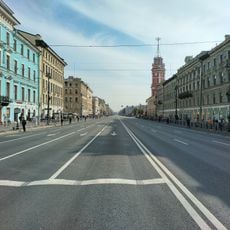
Kotomin House, Classical architectural structure on Nevsky Prospekt, Saint Petersburg, Russia
Kotomin House is a classical structure on Nevsky Prospekt designed by architect Vasily Stasov between 1812 and 1815. Its facade displays Doric half-columns and stands at a major intersection in the city center.
The first house here was built in 1705 for Admiral Cornelius Cruys, though he lived elsewhere; a 1736 fire destroyed it. Court tailor Johann Neumann then had Mikhail Zemtsov build a two-storey stone house in 1738. Merchant Konon Kotomin, freed from serfdom some twenty years earlier, bought the plot in 1807 and had Vasily Stasov rebuild it in high classicism between 1812 and 1815.
The confectionery opened by Wolf and Beranget in the 1810s became known for chocolate eggs with relief scenes of Russo-Turkish war victories. By the 1820s local magazines called it the city's best confectioner's shop. A Chinese cafe operated on the same premises from 1834, drawing writers including Pushkin, Lermontov and Dostoevsky.
The building stands at Nevsky Prospekt 18, between Bolshaya Morskaya Street and the Moika River embankment. Its main facade runs 80 metres along the avenue, with seven-axis risalits and loggias at each side. The Literary Cafe on the ground floor occupies the site of the former Wolf et Beranget confectionery.
The first Russian wax figure cabinet opened here in 1738 and 1739, showing French and English monarchs and their courtiers; it lasted only briefly. In 1743 the German merchant Johann Daniel Albrecht sold tableware made of serpentine stone, then believed to repel poison.
The community of curious travelers
AroundUs brings together thousands of curated places, local tips, and hidden gems, enriched daily by 94,060 contributors worldwide.