Lunacharsky Theatre, Drama theatre in Sevastopol, Ukraine.
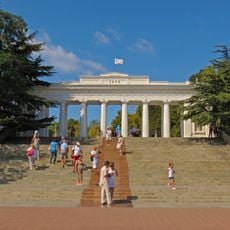
The Lunacharsky Theatre occupies a purpose-built venue at Nakhimov Avenue 6, completed in 1954–1956 to a design by architect V. V. Pelevin. Its eight-column portico carries a pediment with three sculptures representing Sevastopol's naval glory and peaceful labour; ten-metre arched windows open onto a gallery under the portico meant as a summer foyer. The side facades bear relief portraits of Shchepkin, Yermolova, Stanislavsky, Pushkin, Ostrovsky and Gorky.
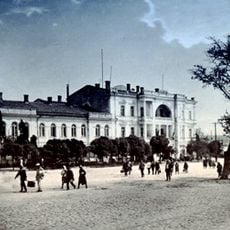
The theatre traces its origins to the Renaissance Art Theatre, consecrated on 14 September 1911 and opened the next day on Primorsky Boulevard. On 14 December 1920, by order of the Sevastopol Revolutionary Committee, it was renamed after Lunacharsky. The present building, designed by architect V. V. Pelevin, was erected in 1954–1956; the company opened its first season there in 1957 with Vsevolod Vishnevsky's "Optimistic Tragedy".
The theatre is named after Anatoly Lunacharsky, the first Soviet People's Commissar of Education; it was renamed by order of 14 December 1920 at the initiative of singer Leonid Sobinov, who headed Sevastopol's arts subdepartment. Its stage has hosted touring productions of Gogol, Chekhov and Ostrovsky, and since 2000 the company has run the international festival "Chersonese Games".
The venue sits in central Sevastopol and is straightforward to reach. Performances take place regularly throughout the week, so it helps to check current schedules and any visitor requirements before your visit.
On 16 (29) December 1917, the theatre then called Renaissance hosted a joint meeting of Black Sea Fleet ships' committees, fortress garrison units and the Sevastopol Soviet presidium, which formed the permanent Sevastopol Military Revolutionary Committee.
The community of curious travelers
AroundUs brings together thousands of curated places, local tips, and hidden gems, enriched daily by 94,410 contributors worldwide.