Borga-Kash, Federal cultural heritage landmark in Nazranovsky District, Russia
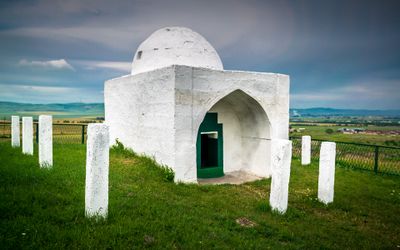
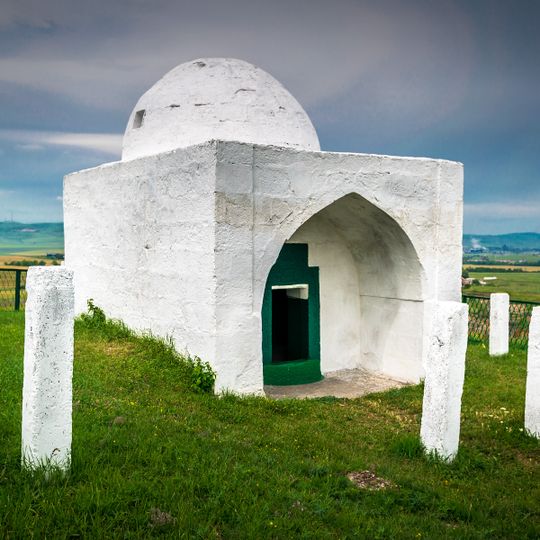
Borga-Kash is a white stone mausoleum on the left bank of the Sunzha, at the northwestern edge of Pliyevo in Ingushetia's Nazranovsky District, 652 m above sea level. It measures 5.5 m long, 4 m wide and 3.2 m high, with a rectangular base and a semicircular dome. A pointed arch crowns the low entrance on the south side, above which three slabs carry Arabic inscriptions.
Built in 808 AH (29 June 1405 – 17 June 1406), as three Arabic inscriptions above the entrance state, the mausoleum was intended for Bek-Sultan, son of Khudainad. It is among the earliest surviving Muslim monuments in the North Caucasus and the oldest Bragun mausoleum in Ingushetia. Scholars link its name to the Borghan ethnographic group of the Nogai people.
The name Borga-Kash means "grave of Borghan" in Ingush, and scholars link the monument to the Borghan, an ethnographic group of the Nogai people. The Arabic inscriptions above the low entrance record the burial of Bek-Sultan, son of Khudainad, and give the Hijri year 808.
The mausoleum stands on the left, hilly bank of the Sunzha at 652 m above sea level, on the north-western edge of Pliyevo in Nazranovsky District. The ground of the slope is uneven, so sturdy footwear helps. The entrance with its pointed arch and three inscribed slabs faces south.
The name Borga-Kash means "grave of Borghan" in Ingush, and scholars link the monument to the Borghan, an ethnographic group of the ancient Nogai people. The Arabic inscriptions above the low entrance name Bek-Sultan, son of Khudainad, as the person buried here.
The community of curious travelers
AroundUs brings together thousands of curated places, local tips, and hidden gems, enriched daily by 93,640 contributors worldwide.