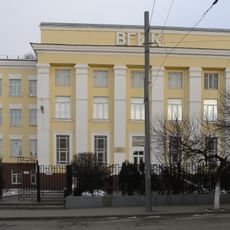
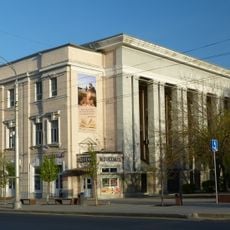
High party school building, Neoclassical educational building in Rostov-on-Don, Russia.
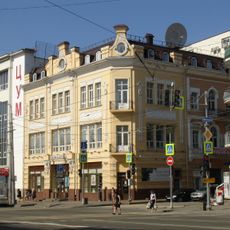
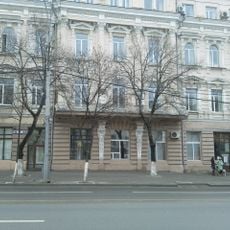
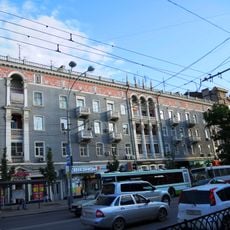
The High Party School building is a neoclassical structure in Rostov-on-Don featuring a P-shaped floor plan. Ionic pilasters decorate the exterior across multiple stories along Budenovsky Avenue.
Designed by architect G. A. Petrov with N. G. Khudoverov, the building was erected between 1953 and 1956 at the junction of Stalinist neoclassicism and Khrushchev functionalism. A Central Committee decree of 4 November 1955 against excesses in design removed the obelisks from the parapet balustrade and the figures from the main facade niches. Since the mid-1980s, subsidence from a nearby underpass and leaking utilities has caused cracks and falling cornices, now countered by the building's owner, the Rostov branch of the Customs Academy.
The building's cultural value lies in its ceramic detailing: upper floors are clad in ceramic tiles, with ceramic capitals, column bases, cornice blocks and relief inserts of garlands and rosettes made by local factories. Sculptor V. V. Barinov carved bas-reliefs on the theme of enlightenment above seven ground-floor windows in arched niches, the only such authorial work in Rostov of that period.
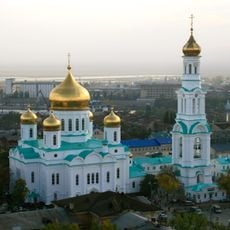
The building stands at the corner of Budyonnovsky Avenue and Moskovskaya Street, house 20/45, on the north side of the square facing the five-domed cathedral. An underground passage built nearby in the mid-1980s caused foundation settlement, so cracks and damaged cornices are still being repaired by the current owner, the Rostov branch of the Customs Academy.
Seven arched niches above the ground-floor windows hold bas-reliefs on the theme of enlightenment, carved by sculptor V. V. Barinov. The sources record this as the only case of such authorial sculpture work in Rostov in those years, a detail easily missed at street level.
The community of curious travelers
AroundUs brings together thousands of curated places, local tips, and hidden gems, enriched daily by 93,710 contributors worldwide.