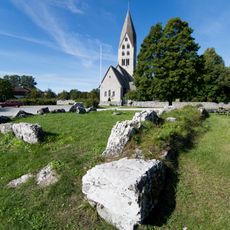
Bulverket, Medieval fortification in Tingstäde, Sweden
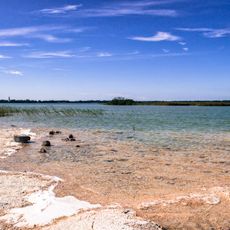
Bulverket is the collapsed remains of a wooden fortification in Lake Tingstäde, Gotland, built in the 1130s. Its core was a square platform 170 m per side, formed by four piers on log caissons, with houses and storage sheds; a double palisade of driven piles stood up to 50 m out, giving a total diameter of about 250 m. The logs now lie scattered over 40,000 m² of the lake bed.
Built in the 1130s according to a 1989 survey, the fortress stood in Lake Tingstäde and may have been used for less than a century. Its purpose is unknown; theories suggest a refuge during the turbulent end of the Viking Age, a last stand, or a stand against the diocese of Linköping. It was first mentioned in writing in 1868 by Oscar Montelius.
The name comes from the old Swedish bul, meaning log, and verk, something built, related to the English bulwark. Local people called it boulwarki, log-stem building. A saying in northern Gotland, "There is smoke just like when Lake Tingstäde burned", may recall its destruction.
The collapsed timbers lie on the lake bed and are visible through the ice on clear winter days, when the lake is used for tour skating, or from a small glass-bottomed electric boat rented at Tingstäde träsk in summer. The site is not on land, so it is seen from the ice or from the water.
Among the finds were the remains of three boats; one served as the model for the Krampmacken, a Viking boat reconstruction built in 1980 that later sailed old Viking waterways through Eastern Europe. The site also yielded bronze belt fittings, a bell and 17 mounts dated to the Viking Age and early Middle Ages.
The community of curious travelers
AroundUs brings together thousands of curated places, local tips, and hidden gems, enriched daily by 94,368 contributors worldwide.