Biskopskällaren, Cellar ruin of a medieval bishop's palace on Ivö, Skåne County, Sweden
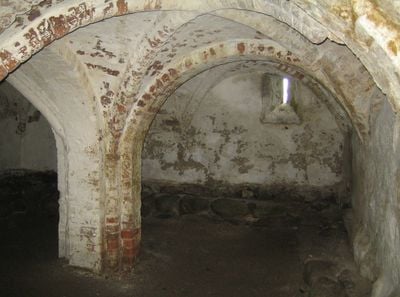
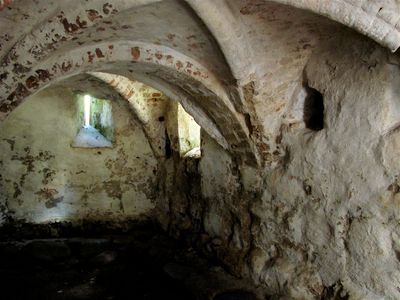
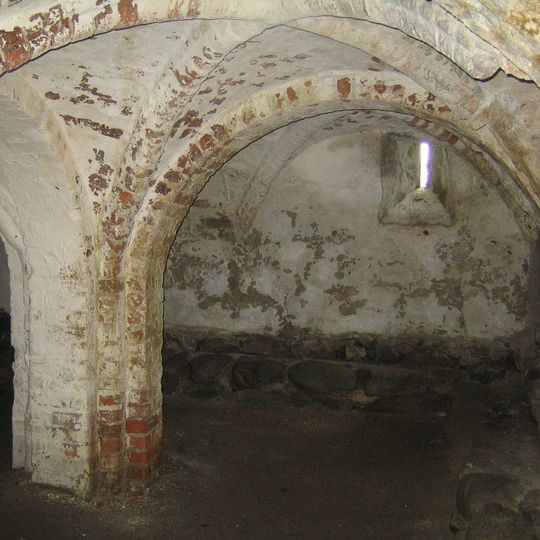
Biskopskällaren is the surviving vaulted cellar of Ivöhus, a bishop's palace built around 1220 for Archbishop Anders Sunesen on the island of Ivö in Skåne. The cellar measures 9 by 8 metres, with one-metre-thick grey stone walls, two pillars and six brick cross vaults. Narrow light slits and a stone stair from the west lead into the room, and stone benches run along the walls.
The cellar is the last remnant of Ivöhus, a bishop's palace built around 1220 for Anders Sunesen, archbishop of Lund, possibly over a 12th-century tower. Sunesen lived here from 1223 until his death in 1228. Parts of the building stood until the 17th century; a farm building later covered the cellar, burned after a 1927 lightning strike, and the cellar was excavated in 1938.
The name Biskopskällaren means "Bishop's Cellar", recalling Archbishop Anders Sunesen of Lund, who lived at Ivöhus until his death in 1228. A folk legend held that he had leprosy and lived as a hermit in the cellar; examinations of his skeleton showed arthritis or gout instead. The site is a monument in the Fornminnesregistret.
The cellar lies in the hamlet of Hovgården in the southeastern part of Ivö, reached by a stone staircase from the west. The room is about 9 by 8 metres, with walls one metre thick and narrow light slits; the floor is uneven earth. A low modern roof protects the vaults, and the original cellar rises about half a metre above ground.
A local legend held that Archbishop Anders Sunesen lived as a hermit in the cellar, shunning all contact because he feared spreading leprosy. Examinations of his skeleton, kept embalmed in Lund, showed no leprosy but signs of arthritis or gout.
The community of curious travelers
AroundUs brings together thousands of curated places, local tips, and hidden gems, enriched daily by 95,191 contributors worldwide.