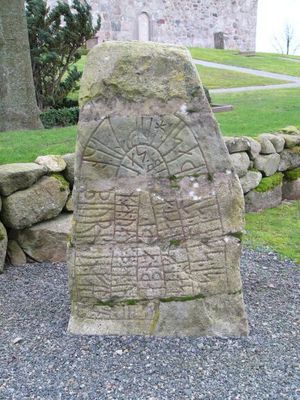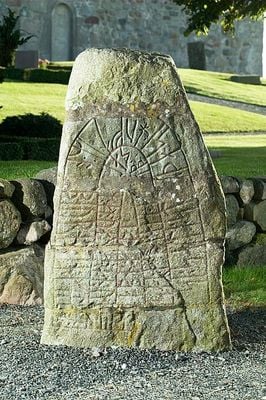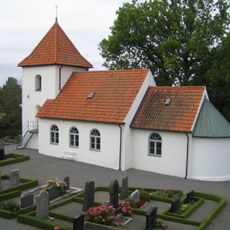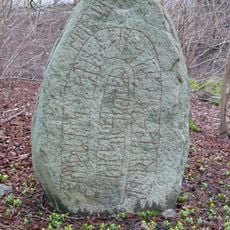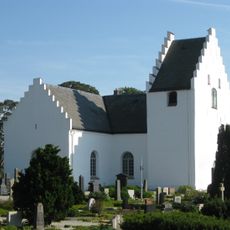
Sjörup Runestone, Norse runestone at Sjörups gamla kyrka, Sweden.
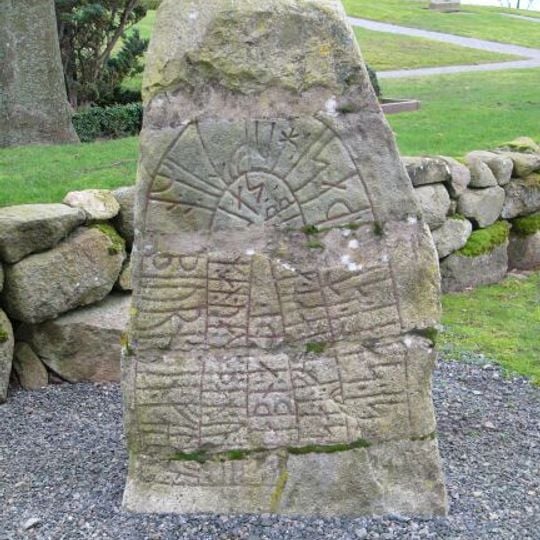
The Sjörup Runestone is a tall, rough-hewn grey granite stone with a rounded top, standing near Sjörup Church. Its face is carved in two zones: above, a circular motif of radiating lines around a cross-like pattern of runes; below, dense horizontal rows of runic text crossed by a vertical rune band and a diagonal line. Patches of green lichen and moss mark its edges.
The Sjörup Runestone was documented as early as the 1620s, when Jon Skonvig drew it for Ole Worm's study of Danish runestones. Two centuries later it was blown into six pieces and reused as building material for a bridge. In the mid-1990s the pieces were recovered, reassembled and the restored stone was raised again near Sjörup Church.
The stone commemorates Asbjörn and connects to events from the Viking Age through its carved text. Such monuments served as lasting records of people and happenings that mattered to their communities.
The reassembled stone stands by Sjörup Church in Ystad Municipality, Scania, in the open air. Visitors reach it on foot from the churchyard; the ground at its base is grass with low stone blocks. It can be viewed at any hour, and the carved faces are best read in low, raking daylight rather than at midday.
The runemaster dropped the h-rune in han ("he") and hafði ("had") but added one at the start of æftiʀ ("in memory of"). This inconsistency shows that Viking Age Scandinavians were unsure whether h should be pronounced before a vowel.
The community of curious travelers
AroundUs brings together thousands of curated places, local tips, and hidden gems, enriched daily by 94,367 contributors worldwide.