Götavirke, Archaeological site in Söderköping Municipality, Sweden
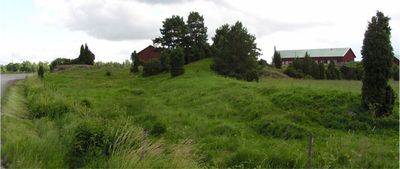
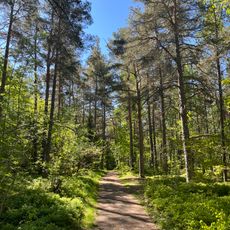
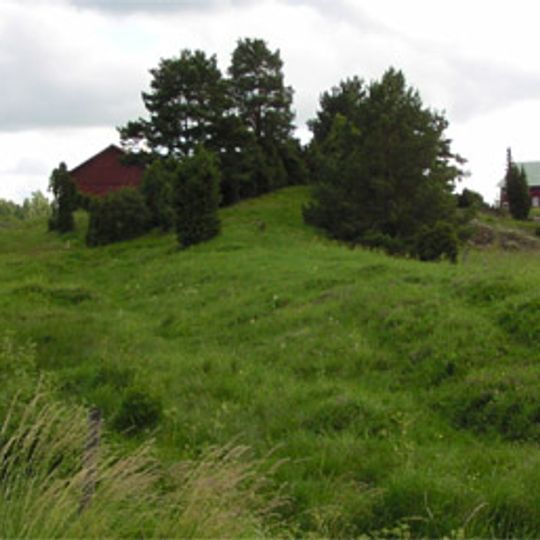
Götavirke consists of the remains of two parallel north–south defensive walls running about 3.5 km between the villages of Västra Husby and Hylinge in Söderköping Municipality, Östergötland. The walls span the gap between lakes Asplången and Lillsjön. The rampart supported a wooden palisade, and behind it traces of a military road have been found.
Götavirke was built around 800 AD to protect the Geatish heartland around Linköping from Baltic Sea attacks. Excavations in 1999 found a hearth in the wall dated by radiocarbon to about 800, and wood chips in the ditch dated to the 1000s, indicating use for at least 200 years. Archaeologist Arthur Nordén, who excavated in 1926, named it after the Danevirke.
The name Götavirke was coined by archaeologist Arthur Nordén, who excavated the wall in 1926 and saw parallels with the larger Danevirke in Schleswig. The Swedish term virke refers to the wooden palisade the earthwork supported. Visitors can still trace the wall's course between the lakes Asplången and Lillsjön.
The site is accessible via Road 210 from Söderköping, with parking available near Hageby farm where the earthworks are most prominent. Walking routes are open year-round, though the terrain can be soft after rain.
The name Götavirke was coined by archaeologist Arthur Nordén, who excavated the wall in 1926 and saw parallels with the larger Danevirke in Schleswig. A 1999 excavation found a hearth in the middle of the wall, radiocarbon-dated to around 800 AD, and wood chips in the ditch dated to the 11th century, indicating the defences were in use for at least 200 years.
The community of curious travelers
AroundUs brings together thousands of curated places, local tips, and hidden gems, enriched daily by 94,244 contributors worldwide.