Bergkvara Castle, Ruined castle and manor estate in Bergunda, Växjö, Sweden
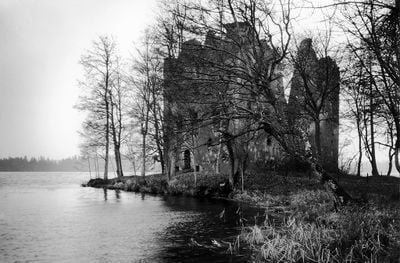
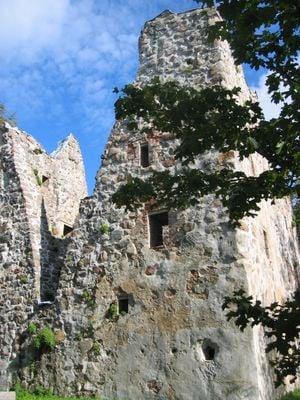
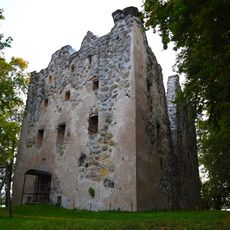
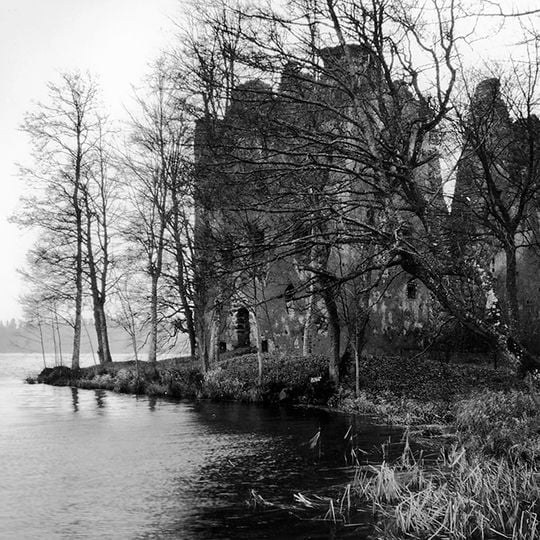
Bergkvara Castle is a ruined stone house on the north shore of Lake Bergkvarasjön, about 6 km west of Växjö. The ruin measures 22 m long, 15 m wide and about 24 m high, with empty narrow window openings and a large tree growing against its right side. A neoclassical main building from the 1790s stands nearby.
Bergkvara is first mentioned in written sources in the mid-14th century, when the squire Magnus Håkansson of the Bergkvara family wrote himself to the estate. The stone house was built in the 1470s by Arvid Birgersson Trolle after the seat farm had been burned during the union conflicts of 1467 and 1469. In 1542, during the Dacke War, Nils Dacke besieged the castle with 2,500 men; after a truce was broken, he returned and burned it. The castle decayed and became a ruin in the 18th century.
The name Bergkvara refers to the estate, whose stone house was built by Arvid Trolle in the 1470s; the Trolle, Sparre and Posse families held it in turn. Carl von Linné visited in 1749, shortly after the roof and hanging towers collapsed in a storm in 1746, and likened the ruin to a bottle case. The present owner is Count Nils Posse.
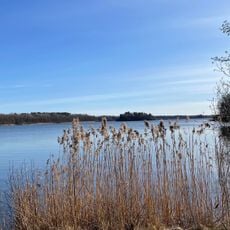
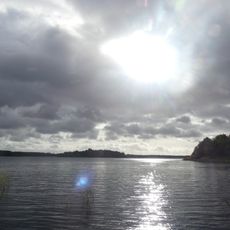
The ruin stands on the north shore of Bergkvarasjön, about 6 km west of Växjö, with the 1790s neoclassical main building beside it. The site is an open, grassy bank at the water's edge; the masonry is uneven and partly overgrown, so watch your footing near the broken wall tops.
The fortress was surrounded by a double moat system that protected the inner walls from attack. The inner moat was later converted into a fish pond in the 1600s, showing how the site was repurposed after the castle fell into ruin.
The community of curious travelers
AroundUs brings together thousands of curated places, local tips, and hidden gems, enriched daily by 94,448 contributors worldwide.