Heby Castle, Manor house in Gnesta Municipality, Sweden
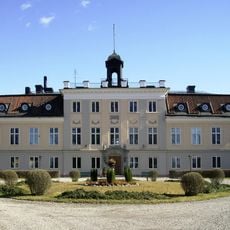
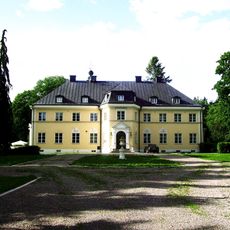
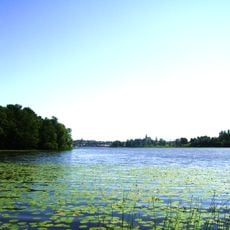
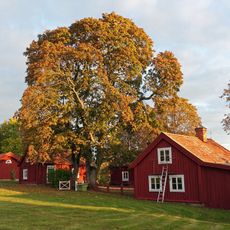
Heby Castle, also known as Heby Slott, is a two-story plastered brick manor house in Gnesta Municipality, in the Swedish province of Södermanland. It sits between Lake Klämmingen and Nyckelsjön, set in an open landscape, and follows a symmetrical plan with a clearly structured main building.
Heby is first mentioned in writing in 1362 as Hedabyum. The present manor was built from 1778 for governor Sven Liljencrantz to drawings by Erik Palmstedt dated January 1778, which are preserved at Heby. The estate became a fideikommiss in 1776 and has been a listed building since 1982.
The name Heby is recorded as early as 1362, in the form "innan bådum Hedabyum", and 1366 as "i öfra Hedeby". The estate's four Marieberg porcelain stoves, including a richly decorated column stove, recall that Sven Liljencrantz and his brother Johan, Gustav III's finance minister, were part-owners of the Marieberg factory.
The manor is a private residence and not open to visitors, but it can be seen from the road or from the shores of the nearby lakes. A visit in the summer months offers the clearest views, as the vegetation tends to be less obstructive than in autumn.
Erik Palmstedt was primarily known for his work on public buildings in Stockholm, and Heby was one of his rare private country commissions. This makes it a useful example of how he adapted his approach to a smaller and more rural setting.
The community of curious travelers
AroundUs brings together thousands of curated places, local tips, and hidden gems, enriched daily by 93,605 contributors worldwide.