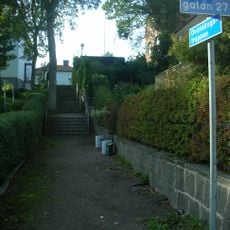
Bagaregården, Residential district in Gothenburg, Sweden.
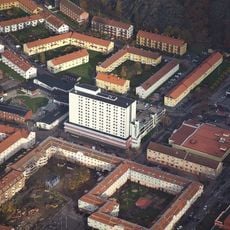
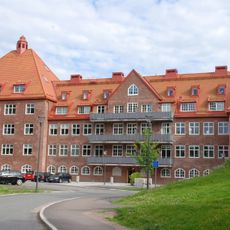
Bagaregården is a district in Gothenburg's Örgryte borough whose 1911 town plan by Albert Lilienberg, inspired by Camillo Sitte, laid out gently curving, tree-planted streets and small squares such as Uddevallaplatsen, Gustavsplatsen and Viloplatsen. Its western part, built 1914–30, consists of landshövdingehus and villas; the eastern area, replanned in 1942, became Strömmensberg with slab and tower blocks built 1944–58.
Urban planner Albert Lilienberg designed the district in the early 1900s, incorporating ideas from Austrian architect Camillo Sitte about city design. These concepts aimed to make life in dense urban areas more human and pleasant.
The name comes from baker Joachim Schönfelt, who in 1651 paid 10 daler and 16 öre for a piece of land at Härlanda. The estate later became known for Johan Minten's popular inn in the late 1700s, where Gothenburgers gathered on spring and summer evenings.
Bagaregården is served by trams along Härlandavägen and Stockholmsgatan, with stops at Bagaregården and Welandergatan. The terrain rises toward Strömmensberg, so expect slopes on foot. The curved streets and small planted squares of Uddevallaplatsen, Gustavsplatsen and Viloplatsen make useful orientation points.
The medieval Härlanda Church ruins lie close to Bagaregården; Gustavus I of Sweden had the church torn down. The district itself grew from the Härlanda estate lands, and the name Bagaregården comes from baker Joachim Schönfelt, who in 1651 paid 10 daler and 16 öre for a piece of land at Härlanda.
The community of curious travelers
AroundUs brings together thousands of curated places, local tips, and hidden gems, enriched daily by 94,524 contributors worldwide.