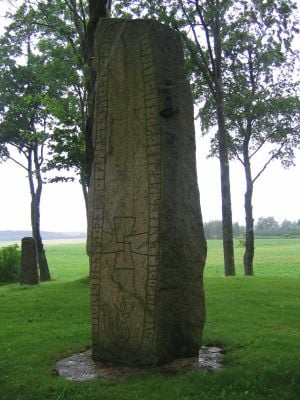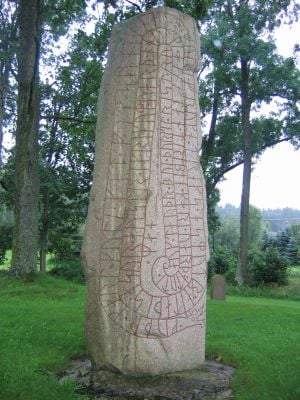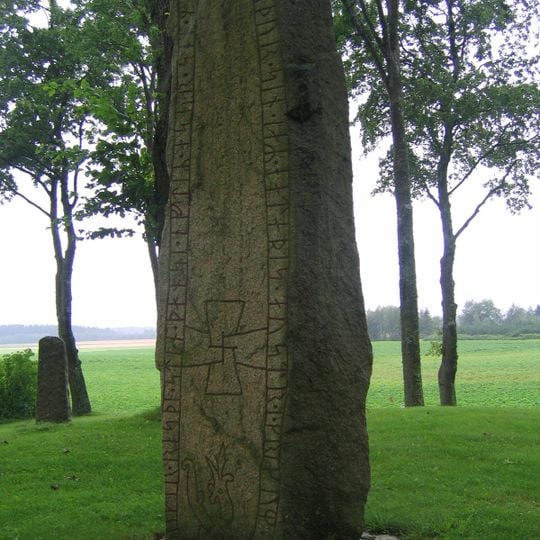
Högby Runestone, Varangian runestone at Högby kyrka, Mjölby Municipality, Sweden.
The Högby Runestone (Ög 81) is a reddish granite slab 3.45 m tall and about 63 cm wide, carved on both faces in the Younger Futhark. Its front honours Assur, who died in Greece; the reverse lists the fates of five sons of Gulli in fornyrðislag verse. Dragon heads in Ringerike style date the carving to 1010–1050.
The stone was raised around 1010–1050, in Ringerike style, at the medieval Högby church. It was walled into the sacristy, drawn by Johan Hadorph in 1687, and re-erected in 1874 when the church was demolished. It commemorates Assur, a Varangian who died in Byzantine Greece, and his four brothers.
The back of the stone is carved in fornyrðislag, an Old Norse metre with paired alliterating lines, listing how Gulli's five sons died. Þorgerðr, Assur's niece, probably commissioned it as soon as she learned of his death in Greece, to secure her inheritance. The stone is known as a Greece stone, a memorial for a man who died in the Byzantine Empire.
The stone stands on the mound where the medieval Högby church once stood, about a kilometre north of the present church, in Mjölby Municipality. It was moved here and re-erected in 1874 when that church was demolished. The setting is outdoors on open ground, so it can be viewed at any time; the carved faces are best read in low, slanting light.
The reverse side is carved in fornyrðislag verse, its lines linked by alliteration, naming all five sons of Gulli and how each died. Þorgerðr probably commissioned the stone as soon as she learned that Assur, the last of her uncles, had died in Greece, to secure her right of inheritance.
The community of curious travelers
AroundUs brings together thousands of curated places, local tips, and hidden gems, enriched daily by 94,391 contributors worldwide.