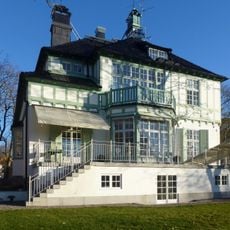
Byströms villa, Embassy in Djurgården, Stockholm, Sweden
Byströms villa at Djurgårdsvägen 21 was built in Roman style with an atrium, rotunda and lantern, using marble from Byström's own quarry in Carrara. Ferdinand Boberg's 1905 rebuilding changed ceiling heights, added rooms and a new wing, and removed much of the original fixed interior. Surviving details include the marble frieze honouring Karl XIV Johan on the upper gallery and the entrance hall's marble columns and floor.
The building was constructed between 1839 and 1844 for sculptor Johan Niclas Byström and later owned by jeweler Christian Hammer and Prince Carl of Sweden. King Alfonso XIII of Spain purchased it in 1928 to establish the Spanish Embassy there.
The building has served as the Spanish Embassy since 1928, when King Alfonso XIII bought it as the official residence of the Spanish ambassador. The name Byström comes from its creator, sculptor Johan Niclas Byström, who built it as a museum for his own works. Inside, a marble frieze honouring Karl XIV Johan remains on the upper gallery.
The villa is the working residence of Spain's embassy, so the building itself is not open to visitors. It stands at Djurgårdsvägen 21 on Djurgården, next to Villa Jägarbacken just to the south. The marble columns and floor of the entrance hall survive from Byström's original interior.
Byström used marble from his own quarry in Carrara and shipped fountains, vases and alabaster columns to Djurgården for the house. He called the project "something devilishly grand" but died in Italy in 1848, four years after it was finished. Inside, a marble frieze honouring Karl XIV Johan survives on the upper gallery.
The community of curious travelers
AroundUs brings together thousands of curated places, local tips, and hidden gems, enriched daily by 93,894 contributors worldwide.