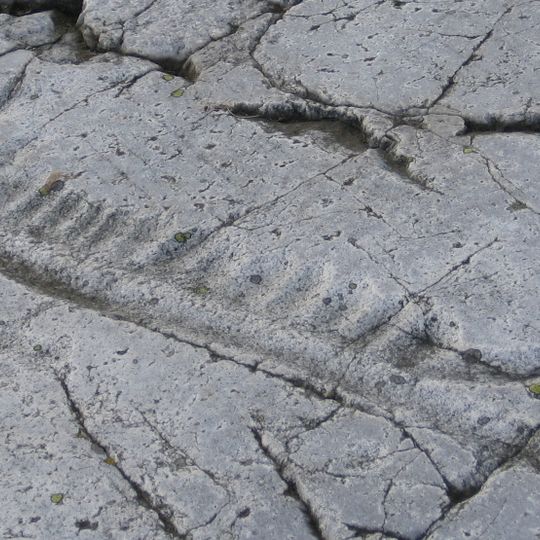
Järrestads hällristningar, Bronze Age petroglyph site in Simrishamn Municipality, Sweden
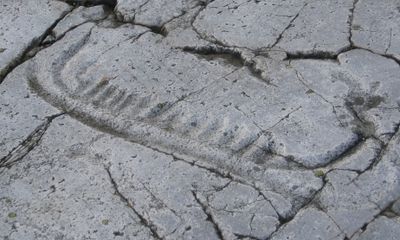
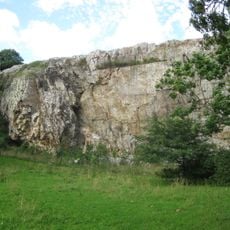
Järrestads hällristningar is a petroglyph site on a 500 m² quartzite outcrop about one kilometre north of Järrestad. Its more than 1200 pecked images cover an area of 22 by 23 metres and include about 700 cup marks, 25 ships, six horsemen, four spirals, four animal figures, three wheel crosses, weapon images and some 210 footprints. The best-known figure is the large human figure called the Dancer.
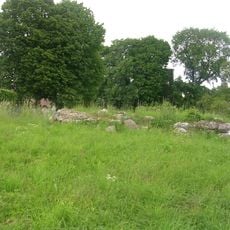
The carvings were pecked into a quartzite outcrop during the Bronze Age, with most activity dated between 1500 and 500 BC. The panel was made by striking the rock with stone tools, and the site was used repeatedly over centuries. Three low burial mounds from the later Bronze Age stand nearby; the largest measures twelve metres across and just under a metre high.
The most famous carving is the large human figure called the Dancer, named for its dancing pose though its meaning is unknown. Around 210 carved footprints, 130 with fully cut toes, are positioned as if an invisible deity walked down the rock toward the south. Interpretations of these images vary widely.
The carvings lie on a quartzite ridge about one kilometre north of Järrestad, along the road toward Gladsax. The panel is exposed in an open pasture, so the surface is best seen in low, raking light; wet stone makes the shallow grooves easier to pick out but also slippery underfoot.
Three burial mounds from the late Bronze Age stand near the rock carvings, visible as distinct earthen heaps. The largest mound displays the characteristic form of these ancient burial monuments and adds another layer to understanding the settlement.
The community of curious travelers
AroundUs brings together thousands of curated places, local tips, and hidden gems, enriched daily by 95,023 contributors worldwide.