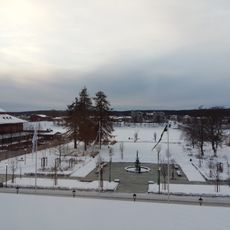
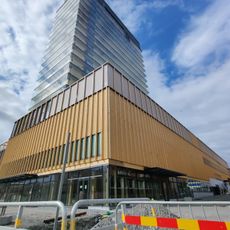
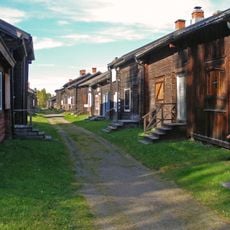
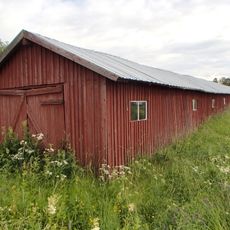
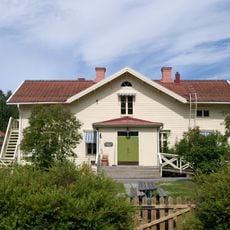
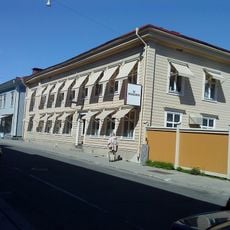
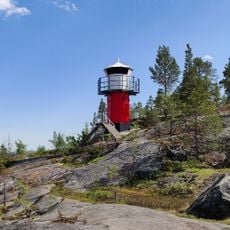
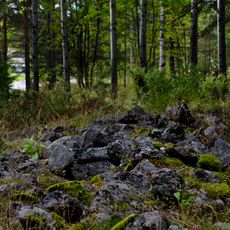
Lejonströmsbron, Wooden bridge and architectural ensemble in Skellefteå, Sweden.
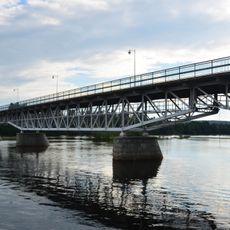
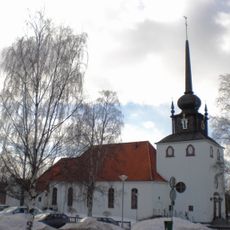
Lejonströmsbron is a wooden bridge 207.5 metres long crossing the Skellefte River between Sunnanå and Prästbordet, near Skellefteå landsförsamling parish church. Its timber deck rests on stone-masonry piers, rebuilt in 1868 when the original wooden caissons were replaced. One approach was replaced by an earth embankment in the 1926–1931 repairs, giving the bridge its present length.
In 1735 the Skellefteå district court decided to build Stora bron, funded by local farm owners, with former soldier Carl Spennare as master builder. It was completed in 1737 at 267 metres, with wooden approaches giving a total length of 314 metres. In 1868 the timber caissons were replaced by stone piers, and repairs between 1926 and 1931 shortened it to 207.5 metres by replacing one side with an earth embankment.
The name Lejonströmsbron comes from the nearby Lejonströms sawmill; until Parkbron opened in 1913 the bridge was simply called Stora bron. Local tradition holds that bullet holes from the 1809 fighting can still be seen in some houses beside the bridge.
The bridge carries pedestrians and cyclists between Sunnanå and Prästbordet, close to the Landskyrka. A speed limit has applied since 1868, when riding or driving faster than a walking pace could cost five riksdaler. The deck is timber, so watch your footing in wet or icy weather.
On 15 May 1809, around 600–800 Swedes under Lieutenant Colonel J. H. Furumark tried to demolish the bridge to slow a Russian force of 6,000 men under General P. A. Shuvalov. They damaged it enough that only infantry could cross, then retreated over the ice. Tradition holds that bullet holes from the battle can still be seen in some houses near the bridge.
The community of curious travelers
AroundUs brings together thousands of curated places, local tips, and hidden gems, enriched daily by 93,971 contributors worldwide.