Leksand Church, Church in Leksand, Sweden
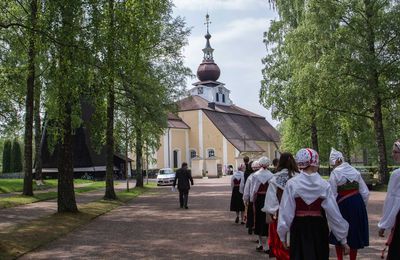
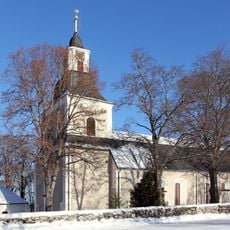
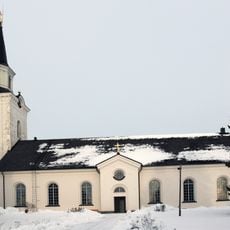
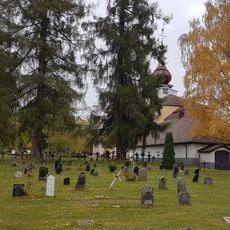
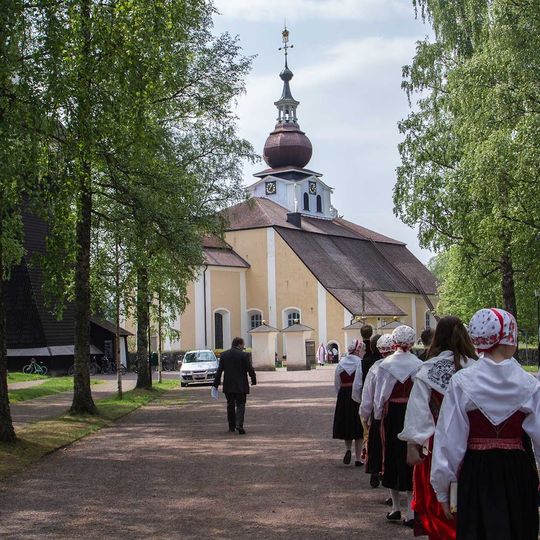
Leksand Church is a stone church at the tip of the northern headland where the Österdalälven leaves Lake Siljan. Its oldest parts date to around 1300, and a central onion dome built in 1709–1715 sits on the roof. Inside, tiered galleries called skullar line the walls, and the bells hang in a separate bell tower outside.
Archaeological digs by Gerda Boëthius found Christian burials here from the 1000s and traces of a square stone foundation, likely a 1100s stave church. A rectangular church replaced it around 1200, and the oldest parts of the present building date to about 1300. A tall tower was added around 1425–1450, Dalarna's first; after lightning fires in 1627 and 1709, the bells were moved to a separate bell tower completed in 1630, and the onion dome was built 1709–1715.
Women's aprons, worn with the skirt, showed which Sunday or feast day of the church year it was. In older times parishioners travelled to church by village in church boats, landing below the church after the sand slopes at a spot called Barkdal. Inside, the congregation sat on large galleries called skullar, divided into gubbskullen, käringskullen and soldatskullen.
The churchyard slopes gently toward the water, so visitors should wear comfortable shoes for walking on grass and uneven ground. Inside, the wooden pews are original and narrow, and light levels are dim, so allow a moment for your eyes to adjust when entering from bright daylight.
The church bells hang not in the tower but in a separate bell tower outside the churchyard wall, completed in 1630 after a lightning fire destroyed the old tower in 1627. The churchyard is called by Vilhelm Moberg "one of Sweden's most beautiful cemeteries"; Hugo Alfvén and Rune Lindström are buried there.
The community of curious travelers
AroundUs brings together thousands of curated places, local tips, and hidden gems, enriched daily by 94,651 contributors worldwide.