Sankt Olofs kyrkoruin, Medieval church ruins in Sigtuna, Sweden.
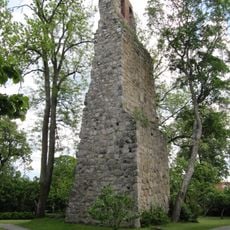
Sankt Olofs kyrkoruin is a ruined stone church in Sigtuna with a central tower, choir and transept built around 1100, and a shortened nave added later. Its ground plan measures 24.5 m long, with a 19.2 m transept and an 11.5 m wide nave. Small, tapering windows follow Anglo-Saxon models, and the layout resembles St Olaf's Church in Nidaros (Trondheim).
Sigtuna was a bishop's seat from 1060, when Adalvard the Younger was installed, until the see moved to Gamla Uppsala in 1164. Sankt Olof was built around the middle of the 12th century, possibly later, after the town had lost that status. Excavations in 2005 found the foundations of an older stone church deep beneath the floor, and the nave was planned longer than it was built.
The site honors Saint Olav, a Norwegian king whose veneration spread across Scandinavia during medieval times. Visitors can still see a spring near the ruins that locals have long associated with healing properties.
The ruin stands on the cemetery ground west of Mariakyrkan, in the eastern edge of medieval Sigtuna. The walls are well preserved and can be walked around freely; the spring and well lie just south of the choir. The site was closed for restoration in 2018 and has since reopened.
The church ranks among the oldest stone churches in Nordic countries and displays construction techniques typical of the 11th century. This early building method sets it apart from later medieval structures in the region.
The community of curious travelers
AroundUs brings together thousands of curated places, local tips, and hidden gems, enriched daily by 93,788 contributors worldwide.