Črna Prst, Mountain summit in Julian Alps, Slovenia
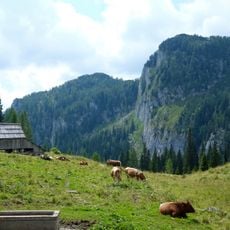
Črna Prst is a 1,844-metre summit in the southeastern Julian Alps, on the edge of Triglav National Park. Its Slovene name means 'black soil', after a dark patch of shaley claystone and psilomelane ore near the top. A mountain lodge, Dom Zorka Jelinčiča, stands on the mountain.
Under the 1920 Treaty of Rapallo the ridge around Podbrdo became the border between Italy and Yugoslavia. In 1921 Italian soldiers marked it with numbered concrete milestones and built guard huts at Črna Prst, Slatnik, Porezen, Grant and Podbrdo; the one on Črna Prst was the highest and was manned only in summer. From 1927 the 7th Alpini Regiment cut military trails up from Podbrdo by hand, with shovels, hand drills and dynamite. The 1947 Treaty of Paris moved the border away.
The mountain's name, literally 'black soil', comes from a dark patch of shaley claystone and psilomelane ore near the summit. Botanists have climbed here for over two centuries: Franz Xaver von Wulfen mentioned a Geranium argenteum sample sent to him by Karl von Zois in 1789, Žiga Graf published on the flora in the 1830s, and Muzio Tommasini, mayor of Trieste, visited in 1840.
The mountain can be reached via hiking trails from the nearby mountain hut Dom Zorka Jelincica, which offers overnight stays and serves as a base for exploring the region. Visitors should prepare for alpine conditions and check weather before attempting the ascent.
Črna Prst is the classic locality for Hacquet's lousewort (Pedicularis hacqueti) and the Julian lousewort (Pedicularis julica), and the typical site of the Apollo butterfly subspecies Parnassius apollo rhea. The dark summit patch that gives the mountain its name is psilomelane, a manganese ore in shaley claystone.
The community of curious travelers
AroundUs brings together thousands of curated places, local tips, and hidden gems, enriched daily by 93,462 contributors worldwide.