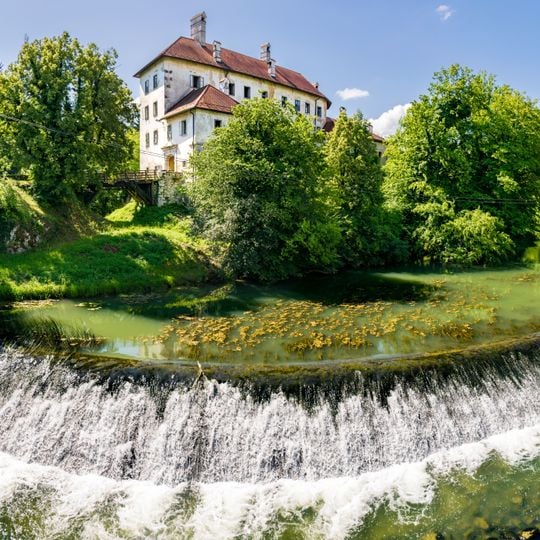
Castle Gradac, Renaissance château in Metlika, Slovenia.
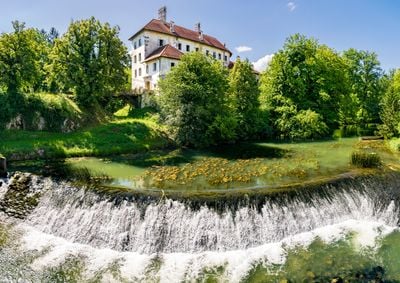
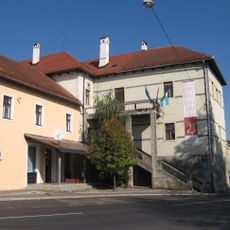
Gradac is a multi-storey castle on a bend of the Lahinja River, made up of the Visoki grad (high castle) and the 19th-century Nizki grad (low castle), a former school and stables. Pale plastered walls, rows of small rectangular windows and steep red tiled roofs are visible, with a square tower rising at the rear. A wooden footbridge crosses the former moat, and the remains of a burned stable stand in the courtyard.
First mentioned in 1228 as the fortress "Graecz", likely named after owner Herbort von Graecz. The Gusič barons held it from 1661 to 1846, and an earthquake half-ruined it in 1640. The state took ownership in 1999; since 2007 research has uncovered Baroque and Classicist wall paintings in all rooms.
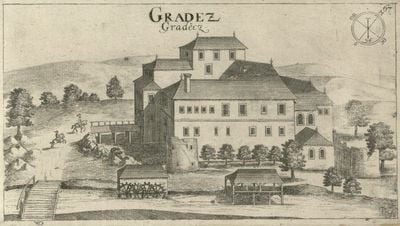
The village still pronounces the name with a characteristic half-vowel 'e', as in the old form 'Gradez' recorded by Valvasor. The long influence of the Croatian Gusič barons likely turned the typical Slovene ending '-ec' into '-ac', common across the Kupa region. The castle park, laid out in the 17th century under the Gusič family, belongs to Slovenia's garden-architectural heritage.
The grounds are accessible for exploring the outer areas and park without special equipment needed. Keep in mind that parts of the castle may be restricted for visits, so it helps to check conditions ahead of your trip.
The castle's park was laid out in the 17th century under the Gusič family, who owned the estate from 1661 to 1846. Its roughly hundred-metre avenue of plane trees and spruces was illegally felled in the 1990s, after Slovenian independence; only stumps remain. A wooden footbridge over the former moat, rebuilt in 2024, now leads to the courtyard where the burnt-out stables still stand.
The community of curious travelers
AroundUs brings together thousands of curated places, local tips, and hidden gems, enriched daily by 94,334 contributors worldwide.