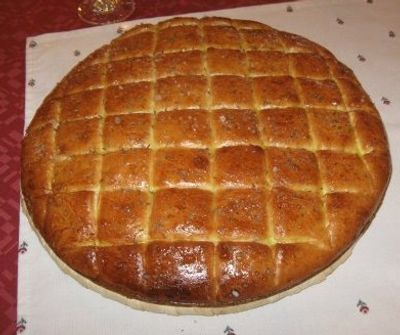
Belokranjska pogača, Traditional flatbread in White Carniola, Slovenia.
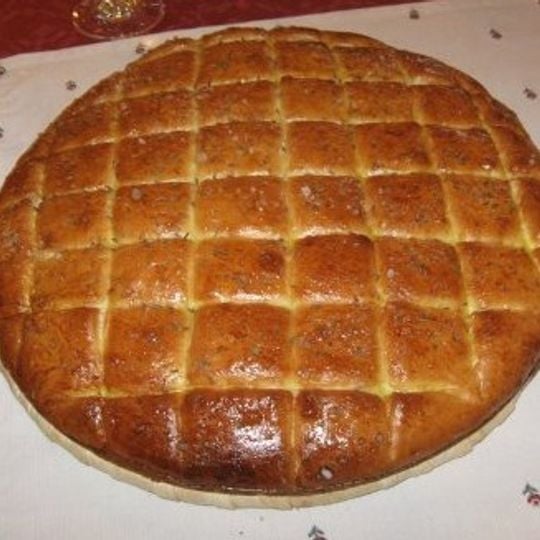
Belokranjska pogača is a round flatbread from the Metlika area of White Carniola, Slovenia. It is made from white wheat flour, water, yeast and salt, risen, then stretched 1–2 cm thick in a buttered pan, scored into squares, brushed with beaten egg and topped with cumin and coarse salt. It bakes at 200–220 °C for 20–25 minutes and is 3–4 cm high in the centre, 1–2 cm at the edge.
The recipe reached White Carniola with the Uskoks, who fled the Turkish invasion of the Balkans in the 15th and 16th centuries and settled on the Žumberak (Gorjanci) range. The bread is mentioned in Janez Trdina's Bajke in povesti o Gorjancih (1882) and Ivan Navratil's Kresovanje v Metliki (1849); the recipe appears in Minka Vasičeva's Dobra kuharica (1902).
The squares are broken off by hand along the scored lines, without a knife, and offered to guests as a welcome with Slovenian wine; popular tradition holds that the bread absorbs alcohol effectively. The name means flatbread of White Carniola, after the Metlika area it comes from.
This flatbread is best enjoyed fresh, as it dries out quickly and loses its soft texture over time. It works well for sharing at meals and pairs nicely with other local dishes from the region.
Belokranjska pogača holds the EU Traditional Speciality Guaranteed mark, not a protected designation of origin; the certificate was confirmed in Brussels. Its squares are broken off by hand along the scored lines, without a knife, and are served to guests as a welcome or during Slovenian wine tastings, since folk tradition holds that they absorb alcohol effectively.
The community of curious travelers
AroundUs brings together thousands of curated places, local tips, and hidden gems, enriched daily by 94,027 contributors worldwide.