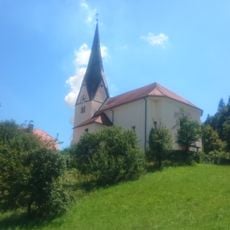
Gutenbuchel Mansion, Historic mansion in Ravne, Slovenia.
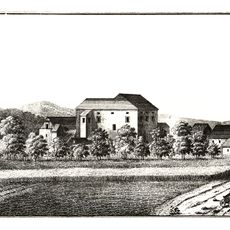
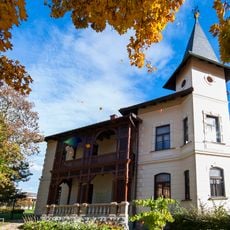
Gutenbuchel Mansion is a single-storey rectangular building on a gentle rise in a park in Ravne pri Šoštanju. After a fire in the late 17th century it was rebuilt without fortifications, as shown in Vischer's 1681 topography. The 1931 renovation by Franz and Marianna Vošnjak added a neo-Romantic tower on the east side and a semicircular annex on the west. Inside, rooms retain parquet floors, wooden panelling and inlaid furniture; a ceiling beam in the first-floor salon bears the year 1926 and the initials MW.
First documented in the 16th century, the mansion was the legal successor of Forhtenek Castle and took shape after that castle was abandoned in the mid-17th century; a fire at the end of the 17th century led to a rebuild shown in Vischer's 1681 topography as a plain single-storey rectangular building. Owners changed rapidly, from Karel Hohenwart in 1489 to the Hohenwart counts (1651–1741) and Baron Franc Ksaverij Gallenstein, who bought Ravne pri Šoštanju in 1764. In 1925 the Šoštanj industrialist Woschnagg (Vošnjak) bought it for 1.25 million dinars, and in 1931 Franz and Marianna Vošnjak rebuilt it inside and out; the family held it until 1945, when it was nationalised. From 1963 to 2013 it housed a department of the Vojnik Psychiatric Hospital, and in 2006 it was declared a cultural monument of the Municipality of Šoštanj.
The mansion is also called Marovška graščina, a local name alongside Gutenbuchel. Since December 2015 it has hosted an Advent exhibition and an Easter exhibition, both now held every year. The 1931 interior includes inlaid furniture and a ceiling beam in the first-floor salon marked with the year 1926 and the initials MW.
The mansion stands on a gentle rise in a park in Ravne pri Šoštanju, with the park laid out in three terraces running north to south and linked by a large staircase. The fountain with the boy and swan and four tin griffins sits on the lower terrace in front of the building. The interior can be seen during the annual Advent and Easter exhibitions held there since 2015.
The 1931 renovation by Franz and Marianna Vošnjak gave the mansion its present form, including a private hydroelectric plant, a glasshouse and a swimming pool. Marianna, a graduate of an art academy, laid out the park in three terraces linked by a large staircase. A fountain below the house carries a boy with a swan and four tin griffins on pedestals.
The community of curious travelers
AroundUs brings together thousands of curated places, local tips, and hidden gems, enriched daily by 94,622 contributors worldwide.