Ľubovňa Castle, Medieval castle in Stará Ľubovňa, Slovakia
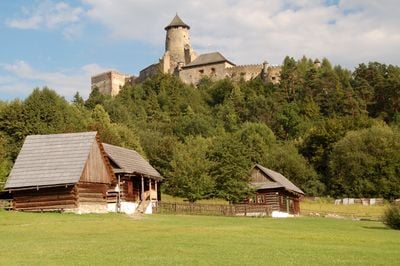
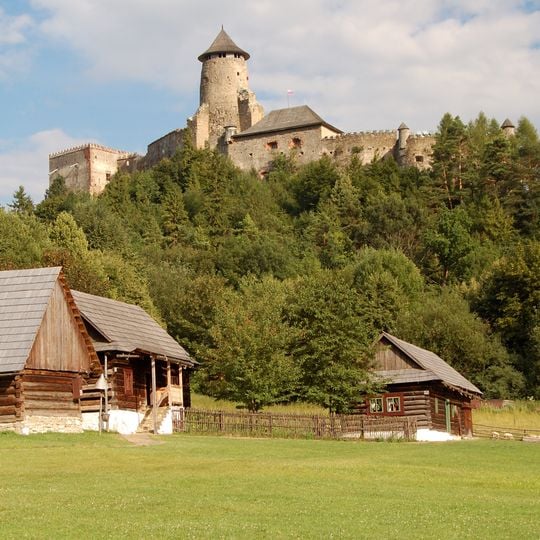
Ľubovňa Castle stands on a limestone hill at 548 metres above sea level, not 711 metres. Its oldest parts are a round tower with massive buttresses and an adjoining Gothic palace on the highest point of the rock, with an eastern palace added later. The buildings form an upper castle with a courtyard, and two further courtyards are laid out on terraces below.
The castle arose in the late 13th or early 14th century as a border guard on trade routes to Poland; a round tower and Gothic palace were its oldest parts. In 1412 Sigismund of Luxembourg pledged it with 13 Spiš towns to Władysław Jagiełło for 37,000 kopas of Prague groschen, and Polish starosts ruled here until 1772. Polish crown jewels were hidden in the castle during the Swedish Deluge, 1655–1661.
The castle museum displays collections on the noble families who owned it, including the Drugeths and the Lubomirski starosts. In the chapel, a permanent exhibition shows copies of the Polish crown jewels, which were hidden here between 1655 and 1661 during the Swedish Deluge. The original jewels were later returned to Poland.
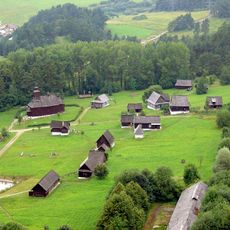
The castle stands on a limestone hill at 548 m above sea level, above the left bank of the Poprad River and the town of Stará Ľubovňa. Visitors reach it on foot from the town, and the terraced courtyards lie on different levels. Below the castle is an open-air museum of Spiš folk architecture.
The castle has three terraced courtyards, not four. The third was laid out in 1647 together with the chapel. Between 1655 and 1661 the Polish crown jewels were kept here during the Swedish Deluge, and in 1656 King John II Casimir Vasa visited the castle.
The community of curious travelers
AroundUs brings together thousands of curated places, local tips, and hidden gems, enriched daily by 95,264 contributors worldwide.