Lubart's Castle, Medieval castle in Lutsk, Ukraine
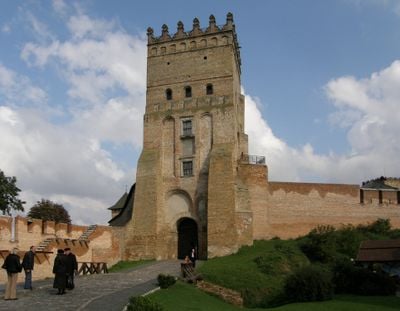
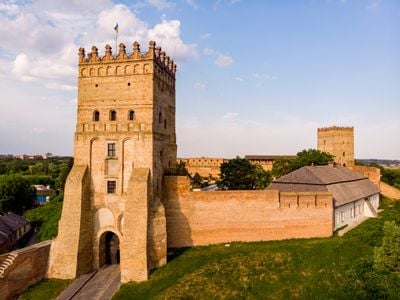
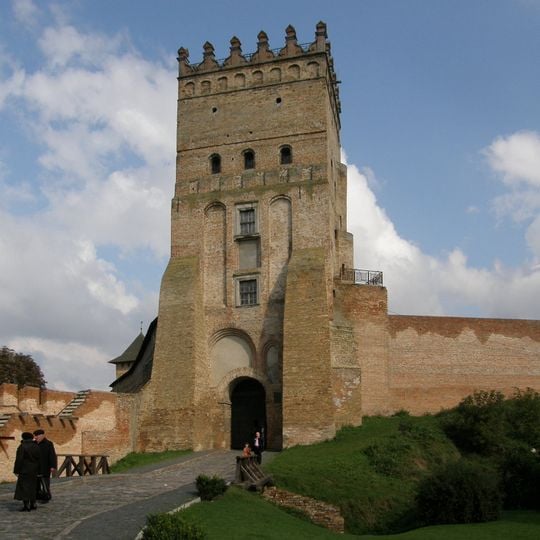
Lubart's Castle is a brick fortress on a triangular hill above the Styr River in Lutsk. Its walls and three towers—the Entrance, Styrova and Vladychna—enclose a courtyard. The Entrance Tower has a pointed-arch gateway and, above it, two walled-up arches that were the old gate and postern, once served by drawbridges.
A wooden detinets stood here from the 10th century and withstood sieges until Burundai's Mongols had it dismantled in 1261. After Volhynia passed to the Grand Duchy of Lithuania, Lubart began a brick castle in the 1350s, largely finished by the 1430s. In 1429 its palace hosted a seven-week congress of European monarchs; in 1431 it withstood a siege during the Lutsk War, and in 1595 it was taken by Severyn Nalyvaiko's troops.
The castle's name honours Liubartas, the Lithuanian prince who began the brick fortress in the 1350s. Within its walls stood two cathedrals, the Latin Holy Trinity and the Orthodox St John the Divine, where the Volhynian nobility of both faiths met for assemblies and regional diets. A special Lutsk Tribunal also sat here, hearing cases from several voivodeships.
The entrance is on the western side, through the gate tower, where the main facade still shows the wide and narrow walled-up arches of the old gate and wicket, once fitted with drawbridges. The defensive walls were raised in the 15th century and their embrasures replaced by two or three rows of loopholes reached by wooden galleries. The grounds are uneven brick and earth.
In 1429, European monarchs gathered here for a major congress, including rulers from the Holy Roman Empire, Poland, Denmark, and Lithuania. This meeting made the castle a significant diplomatic center in Eastern Europe.
The community of curious travelers
AroundUs brings together thousands of curated places, local tips, and hidden gems, enriched daily by 93,701 contributors worldwide.