Astronomical Observatory of Kyiv University, Research observatory at Kyiv University, Ukraine
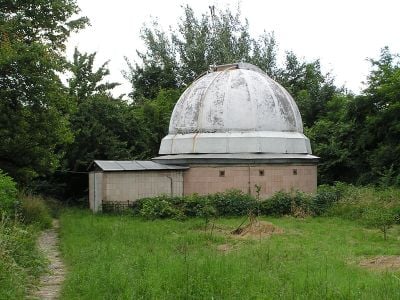
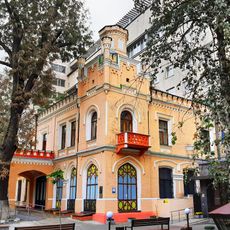
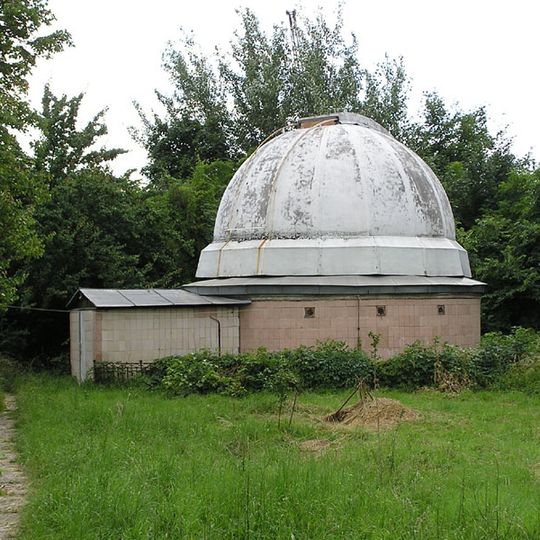
The Astronomical Observatory of Kyiv University occupies about 2.6 hectares on Observatorna Street. Its main building, designed by Vikenty Beretti in a simplified late classicist style, is an octagonal tower with its entrance facing south. A meridian hall with an open terrace stands on the west side, and the central hall keeps four relief-ornamented false columns, a cast-iron staircase and a tiled stove with stucco decoration.
Founded in 1845, the observatory was designed by architect Vikenty Beretti and built between 1841 and 1845, opening officially on 7 February 1845. Its first director was Vasily Fedorov. The main building, an octagonal tower in simplified late classicism, was partially rebuilt between 1860 and 1890. In 1979 it was listed as a national architectural monument, and in 2008 it entered UNESCO's tentative list.
The observatory is named after Taras Shevchenko Kyiv National University, whose council created an extra assistant post only in 1913; for over half a century the staff was just a director and an observer. Its museum holds about 20,000 items, including an 1838 Ertel portable telescope and an 1895 Repsold astrograph. On 7 February 2009 the Kyiv Meridian was inaugurated here.
The observatory stands at Observatorna Street 3, in Kyiv's Shevchenkivskyi district, on a 2.6-hectare site in the city's historic core. The main entrance faces south, and the meridian hall with its open terrace lies on the western side. Visiting the astronomical museum, which holds about 20,000 items, is the main way to see the interiors.
The observatory's museum holds about 20,000 items, among them a portable telescope made by Ertel in 1838, an astrograph by Repsold from 1895 and a Repsold meridian circle from 1870. Staff here discovered the comet Churyumov–Gerasimenko in 1969 and about 600 dwarf galaxies.
The community of curious travelers
AroundUs brings together thousands of curated places, local tips, and hidden gems, enriched daily by 95,170 contributors worldwide.