Waterloo Bridge, Road bridge in central London, England
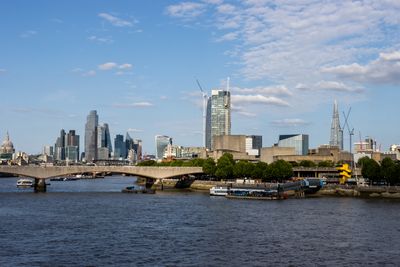
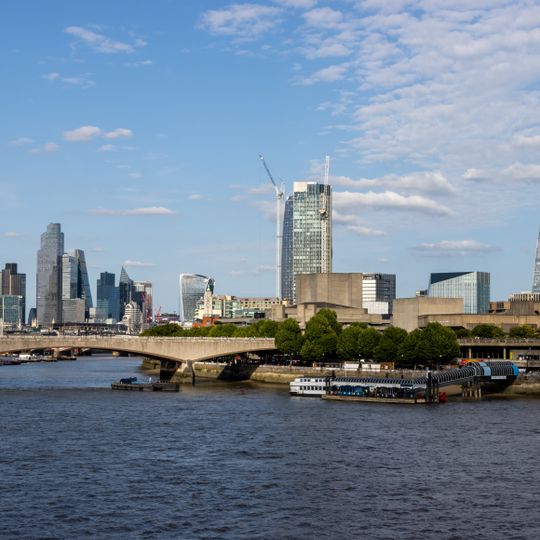
Waterloo Bridge carries the A301 across the Thames from the Strand and Aldwych to the South Bank. Its five shallow spans, about 72 metres each, are not true arches: they are reinforced-concrete box girders clad in Portland stone, with granite-clad piers reused from the 1817 bridge. The deck is 24.38 metres wide, with two 3.35-metre footways.
John Rennie's nine-arch granite bridge opened here in 1817, renamed for the Battle of Waterloo by an 1816 Act. Scour damaged its piers, and demolition began in 1934. Giles Gilbert Scott's replacement was begun in 1937, partly opened on 11 March 1942 and finished in 1945; it is the only Thames bridge damaged by German bombers.
Because so many men were called up, women made up most of the workforce that built the bridge from 1939 onward, and the project was long known as "The Ladies' Bridge". The name commemorates the 1815 victory at Waterloo, and the bridge was given Grade II* listed status in 1981.
Pedestrians have free access across the bridge at all times, walking on pathways on both sides while enjoying views west toward Parliament and east toward river sights. The bridge remains accessible to vehicles as it forms part of the A301 road.
Because so many men were called up, women made up most of the workforce that built the bridge from 1939 onward, and it was known for years as "The Ladies' Bridge". It is also the only Thames bridge damaged by German bombers in the Second World War.
The community of curious travelers
AroundUs brings together thousands of curated places, local tips, and hidden gems, enriched daily by 93,358 contributors worldwide.