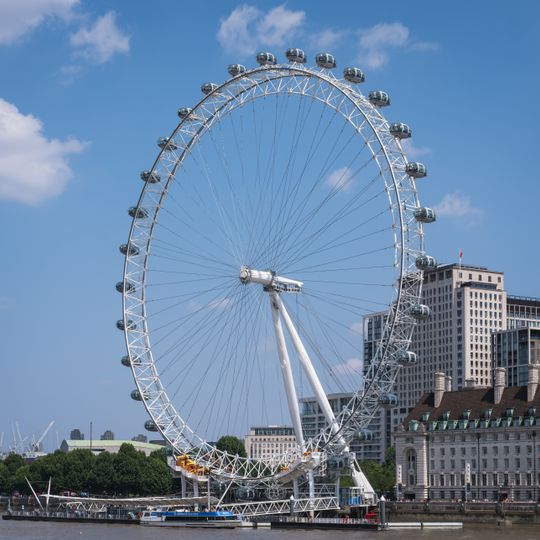
London Eye, Observation wheel at South Bank, United Kingdom.
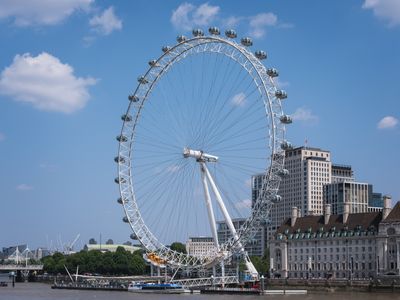
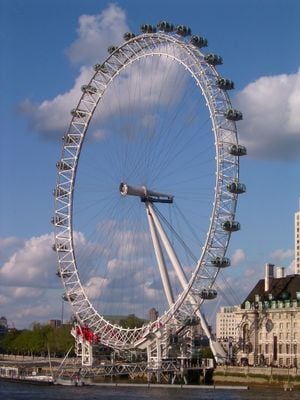
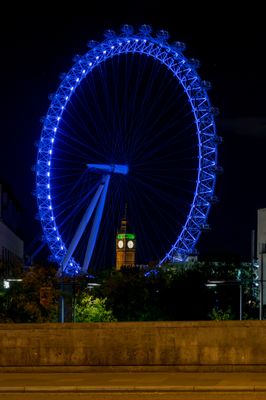
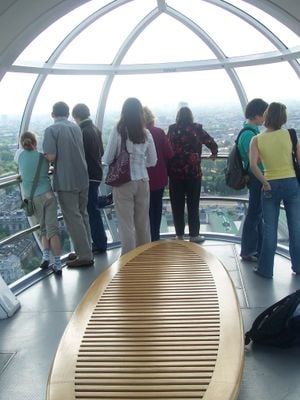
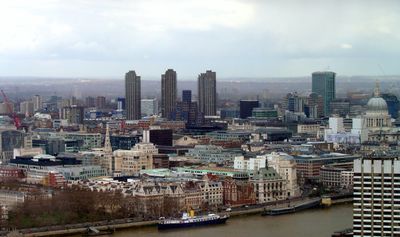
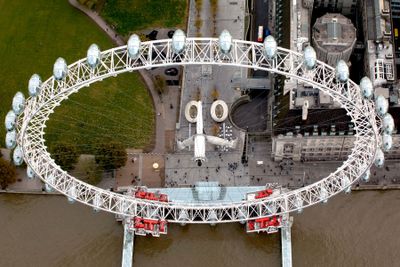
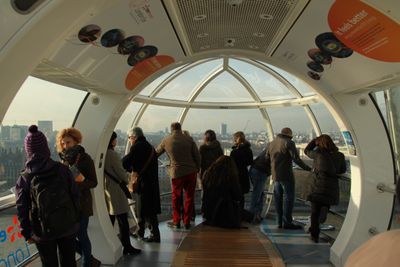
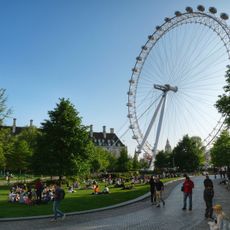
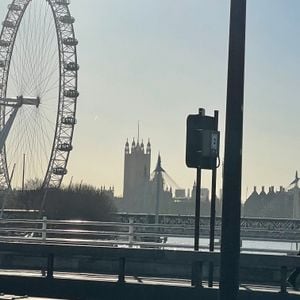
The London Eye is a Ferris wheel on the Thames South Bank in London, consisting of 32 glass-enclosed capsules mounted on a 135-meter (443-foot) steel framework that rotates slowly to offer passengers sweeping views over Westminster and the City. Each capsule is fully sealed, air-conditioned, and holds up to 25 people, while the entire structure turns continuously to reveal a 360-degree panorama across the British capital.
Architects Julia Barfield and David Marks designed the wheel in 1998 for London's millennium celebrations, with construction completed in 1999 and public opening in March 2000. Originally planned to operate for five years, it became a permanent installation after sustained demand from visitors and residents.
This observation structure has become a reference point along the South Bank skyline since the millennium celebrations, helping people find their way around the city and offering a shared meeting place near theatres and galleries. On clear days, walkers and photographers gather along the riverside path to frame the wheel against the Houses of Parliament or the towers of the financial district, watching the capsules turn slowly overhead.
The wheel stands within walking distance of Waterloo and Westminster stations, and each rotation takes 30 minutes while capsules hold up to 25 passengers. Booking online reduces waiting times on site, especially during weekends and school holidays when longer queues tend to form.
The drive system allows continuous passenger boarding without stopping the wheel, which turns at 0.9 kilometers per hour (0.6 miles per hour) to maintain operations without interruption. This speed is slow enough for people with limited mobility to enter and exit safely while the capsules move steadily forward.
Location: Lambeth
Inception: 1998
Architects: Julia Barfield, David Marks, Marks Barfield
Official opening: March 2000
Height: 135 m
Diameter: 120 m
Website: http://londoneye.com
GPS coordinates: 51.50333,-0.11972
Latest update: December 2, 2025 21:41
This collection brings together major technical achievements that have marked the history of modern engineering. From the Hoover Dam on the Colorado, built in 1936 to produce hydroelectric power, to the ITER nuclear fusion project in France, which represents the future of energy research, these structures exemplify human boldness and skill. Each structure serves a specific purpose: crossing natural obstacles like the Brooklyn Bridge, connecting Manhattan to Brooklyn since 1883, facilitating maritime trade with the Panama Canal between the Atlantic and Pacific, or pushing height limits with the Burj Khalifa at 828 meters. These achievements are visited around the world and often offer remarkable experiences. The Eiffel Tower welcomes 7 million visitors each year who ascend to discover Paris from its 324-meter height. Shanghai's Maglev allows travel at 430 kilometers per hour thanks to magnetic levitation. The Millau Viaduct crosses the Tarn Valley at 343 meters above sea level over 2,460 meters in length. These engineering landmarks invite understanding of how industrial architecture has shaped our modern world, combining functional necessity with technical prowess that continues to fascinate visitors worldwide.
Observation wheels allow the exploration of cities and their surroundings from heights ranging from 25 to 250 meters. These steel structures rotate slowly, giving visitors time to observe monuments, watercourses, and neighborhoods spread at their feet. In London, the London Eye looms over the Thames at 135 meters, while in Singapore, the Singapore Flyer stands at 165 meters with views reaching into Malaysia and Indonesia. In Las Vegas, the High Roller rises 168 meters above the lit-up Strip. Each wheel has its unique technical and historical features. The Tianjin Eye in China is integrated into the Yongle Bridge structure above the Hai River. In Vienna, the Wiener Riesenrad in Prater dates from 1897 and retains its original 15 wooden cabins. These attractions offer an alternative way to see cities, taking height for a rotation duration typically between 15 and 30 minutes.
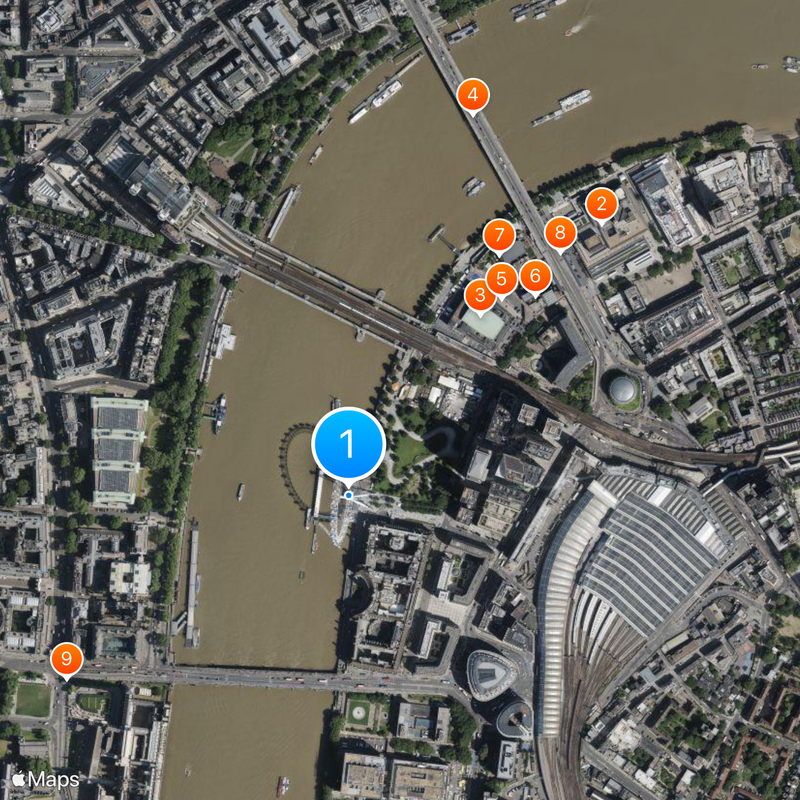
Royal National Theatre
572 m
Royal Festival Hall
345 m
Waterloo Bridge
618 m
Southbank Centre
385 m
Hayward Gallery
422 m
Queen Elizabeth Hall
438 m
Museum of the Moving Image
498 m
Jubilee Walkway
518 m
Purcell Room
441 m
National Poetry Library
335 m
London Pride
586 m
A Room for London
456 m
Southbank Centre Food Market
346 m
Topolski Century
323 m
Royal National Theatre
572 m
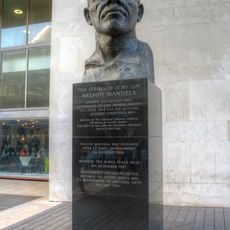
Bust of Nelson Mandela
306 m
Tomb (With Draped Urn) In Churchyard To North West Of Portico Of Church Of St John With All Saints
534 m
Edwards Family Tomb In Churchyard To North-West Portico Of Church Of St John With All Saints
524 m
Peache Family Tomb In Church Yard To North West Of Portico Of Church Of St John With All Saints
520 m
Fountain In Courtyard Of Shell Centre
251 m
Zemran
416 m
5, Whichcote Street Se1
462 m
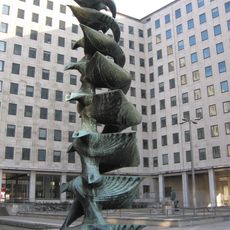
IBM Building
682 m
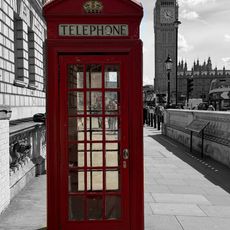
K2 Telephone Kiosk, Outside Cornwall House
534 m
War memorial at St John's Church, Waterloo
524 m
Sharp Family Tomb In Churchyard To North West Of Portico Of Church Of St John With All Saints
522 m
K6 Telephone Kiosk, Outside Cornwall House
562 m
95-123, Stamford Street Se1
647 mReviews
Real people, real opinions — but not verified.
Visited this place? Tap the stars to rate it and share your experience / photos with the community! Try now! You can cancel it anytime.
A giant wheel that takes its time! Very fun if you want to privatize an entire cabin and have an aperitif with the Thames and London in front of you!
Discover hidden gems everywhere you go!
From secret cafés to breathtaking viewpoints, skip the crowded tourist spots and find places that match your style. Our app makes it easy with voice search, smart filtering, route optimization, and insider tips from travelers worldwide. Download now for the complete mobile experience.
A unique approach to discovering new places❞
— Le Figaro
All the places worth exploring❞
— France Info
A tailor-made excursion in just a few clicks❞
— 20 Minutes