National Museum of Natural History, Natural history museum at National Mall, Washington, US
The National Museum of Natural History is a pale gray Neoclassical building on the north side of the National Mall, designed by Hornblower & Marshall and opened in 1910. A gold-tiled dome on a columned drum crowns the roofline; below it, a projecting section with a tall arched window faces a long wing of square windows set between pilasters and columns. Inside are 325,000 square feet of exhibition space, including the Kenneth E. Behring Hall of Mammals and the Janet Annenberg Hall of Geology, Gems and Minerals.
Congress authorized a new building in 1902, and the firm Hornblower & Marshall designed it; the Natural History Building opened on March 17, 1910, and was finished in June 1911 at a cost of $3.5 million. It was the first structure built on the north side of the National Mall under the 1901 McMillan Commission plan.
The museum's name comes from its role as the national collection of natural history, and its halls display objects such as the Hope Diamond and the Star of Asia Sapphire. The Orkin Insect Zoo and the Kenneth E. Behring Hall of Mammals are named for donors and are part of the visitor experience.
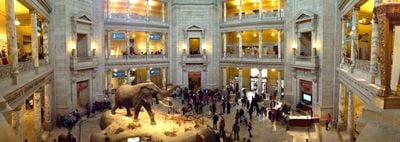
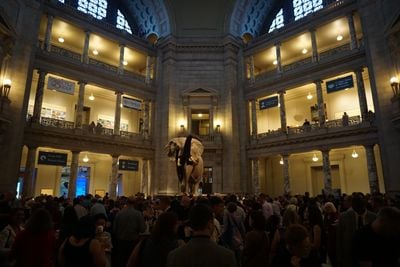
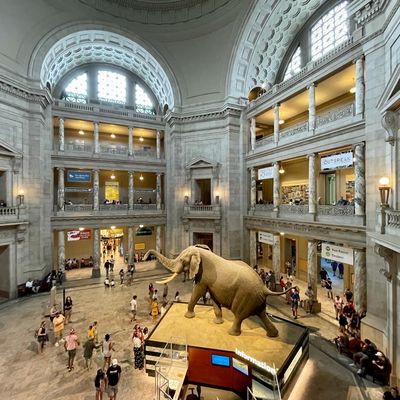
The museum sits on the north side of the National Mall, between 9th and 12th Streets NW, a short walk from the Smithsonian Metro station. Admission is free and it stays open 364 days a year. The entrance on the Mall leads straight into the ground-floor mammal hall.
The museum holds the National Gem and Mineral Collection, whose best-known piece is the Hope Diamond; the Sant Ocean Hall displays a model of a North Atlantic right whale. The Orkin Insect Zoo on the first floor lets visitors watch live insects.
The community of curious travelers
AroundUs brings together thousands of curated places, local tips, and hidden gems, enriched daily by 92,310 contributors worldwide.