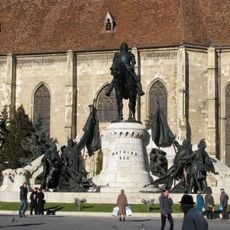
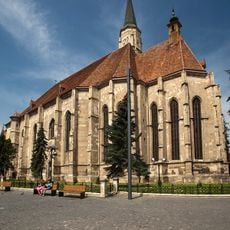
Transfiguration Cathedral, Catholic cathedral in Cluj-Napoca, Romania.
The Transfiguration Cathedral, also called the Minorites' Church, is a Baroque stone-and-brick building on Bulevardul Eroilor, measuring 44.25 m long, 15.44 m wide and 28 m high. Architect Johann Eberhard Blaumann set the entrance in a projecting bay 3.60 m from the facade, and the tower carries a chronogram dated 1782. The ceiling frescoes were painted by Ferenc Lohr in 1908.
Construction took place between 1778 and 1779 after the original structure collapsed due to engineering failures. The rebuilding received financial backing from the Austrian Empress Maria Theresa, allowing the current building to be completed.
The church holds seven Baroque and Empire style honorary monuments, mostly of wealthy Armenian families who gave Mass stipends for its construction. Many benefactors were entombed in the crypt until 1834, when burials inside the city walls were banned during a cholera epidemic. The Hungarian inscriptions on the 19th-century stained glass were destroyed after the Greek-Catholic takeover.
The cathedral sits on Bulevardul Eroilor in central Cluj-Napoca and is straightforward to locate. Since the building functions as an active place of worship, visiting hours may be limited or shifted around service times.
The interior blends Central European baroque design with unexpected Byzantine elements, including an ornate iconostasis added several decades after the building's completion. This later addition reveals how the church evolved to serve its changing congregation.
The community of curious travelers
AroundUs brings together thousands of curated places, local tips, and hidden gems, enriched daily by 93,054 contributors worldwide.