Curtea de Argeș Monastery, Eastern Orthodox monastery in Curtea de Argeș, Romania
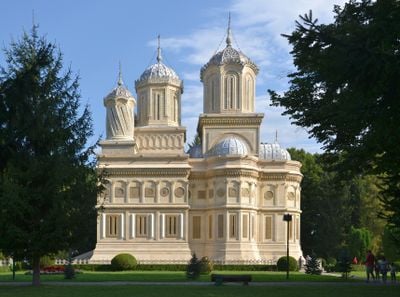
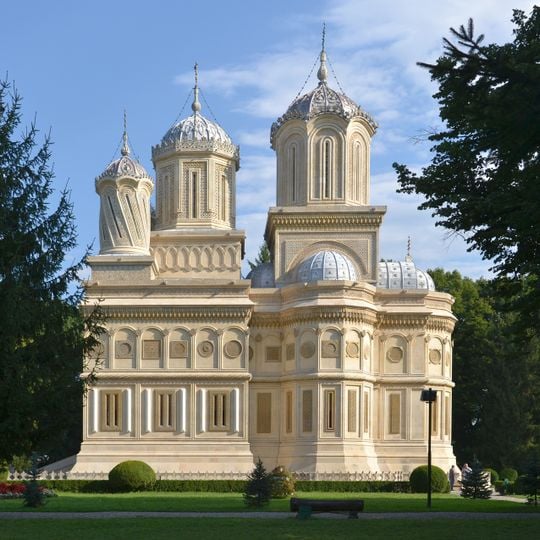
Curtea de Argeș Monastery is an Eastern Orthodox cathedral in Curtea de Argeș, Romania, faced with pale grey limestone over a brick interior. It sits on a raised platform about 2.1 m above the surrounding ground, encircled by a stone balustrade. The oblong building has a many-sided annex at the back, a central dome fronted by two smaller leaning cupolas, and a broader secondary dome rising from the annex; each summit carries an inverted pear-shaped stone with a triple cross.
Neagoe Basarab began the church in 1515 on the site of the first metropolitan seat of Wallachia, and it was finished by 1517; the interior painting by Dobromir was completed in 1526 under Radu of Afumați. Fires in 1866 and 1867 destroyed the seminary, dwellings, chapel and entrance tower. Between 1875 and 1885 André Lecomte du Noüy rebuilt the church, replacing the original fresco, and it was reconsecrated on 12 October 1886.
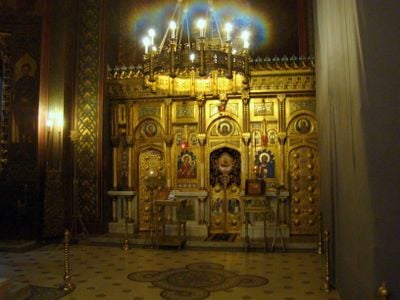
The cathedral is dedicated to the Dormition of the Mother of God, and the monastery has been the seat of the Diocese of Argeș since 1793. The interior frescoes painted by Dobromir in 1526 survive only in fragments, now held at the National Museum of Art in Bucharest. The gilded iconostasis seen today, with its studded doors and medallion portraits, belongs to the 19th-century restoration.
The cathedral sits on a raised platform about 2.1 m above the surrounding ground, encircled by a stone balustrade, so the entrance is reached by steps. The interior is brick covered in plaster and frescoes, and the windows are narrow slits, so light inside is dim. A small open shrine with a dome on four pillars faces the main entrance. The complex is an active monastery and the seat of the Archdiocese of Argeș and Muscel.
The Manole legend says the architect walled his wife Ana into the foundations so the walls would hold; a spring named after him is said to mark where he fell. A tablet inside records that Prince Neagoe Basarab and his wife Milica Despina founded the church, and that Radu of Afumați completed it in 1526.
The community of curious travelers
AroundUs brings together thousands of curated places, local tips, and hidden gems, enriched daily by 93,052 contributors worldwide.