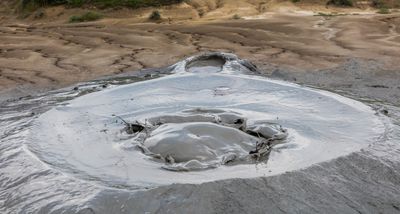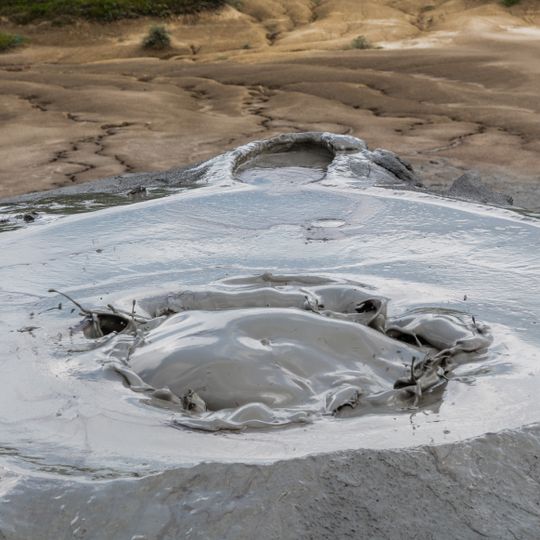
Pâclele Mici Mud volcanoes, Protected natural area in Berca, Romania.
Pâclele Mici Mud Volcanoes is a protected geological and botanical reserve in Berca, Buzău County, Romania, covering 16.5 hectares at an altitude of 341 m. Its cones reach 7–8 m, with craters smaller than those of nearby Pâclele Mari. Wet grey mud builds low mounds whose raised rims enclose shallow pools, and the mud dries into a relatively solid crust. Heavy rain sends mud torrents sliding southward, cutting the badlands of ravines around the cones.
The site lies in the central part of the Berca depression at 341 m, within a protected area of national interest (IUCN category IV, botanical and geological reserve). The mud volcanoes are fed by gases rising from about 3,000 m depth through clay and water; the expelled mud is cold, coming from continental crust layers rather than the mantle. Similar phenomena occur in Italy, Ukraine, Russia and Azerbaijan.
The name Pâclele comes from the regional word "pâclă", meaning muddy patch, and the site is paired with the larger Pâclele Mari nearby. Visitors walk on a crust of dried mud between cones and watch gas bubbles break the surface of the pools. Access is allowed only on dry days to keep the crust from being destroyed.
The site is located around 41 kilometers from Buzău and is reached by a gravel road suitable for regular cars. The best time to visit is in the morning or late afternoon, when the heat is less intense and the light is softer.
The ground around the mud volcanoes contains so much sulfur and salt that only a handful of specialized plant species can survive there. In a few spots, small shrubs grow that cope with extreme dryness and salty soil.
The community of curious travelers
AroundUs brings together thousands of curated places, local tips, and hidden gems, enriched daily by 93,762 contributors worldwide.