Sintashta, Archaeological site in Bredinsky District, Russia.
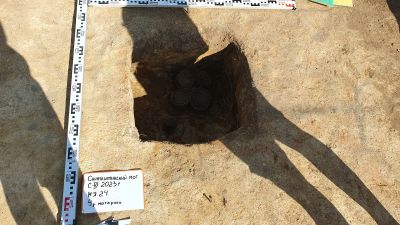
Sintashta is a Bronze Age fortified settlement of rectangular houses arranged in a circle about 140 m in diameter, enclosed by a timber-reinforced earthen wall with gate towers and an outer ditch. The shifting river has destroyed roughly half the site, leaving about 31 of 50–60 houses. A large kurgan rises over the Sintashta cemetery.
The fortified settlement dates to about 2100–1800 BC and is the type site of the Sintashta culture. It was discovered in 1968 by a Ural State University expedition, and excavations led by V. F. Gening and G. B. Zdanovich continued until 1986. The site includes the settlement, the Large Sintashta Kurgan, the Sintashta burial ground, the Sintashta III Kurgan and the Small burial ground.
The settlement was home to herders who mastered metalworking and created bronze objects with distinctive techniques. It reveals how people lived and what crafts they practiced during that era.
The site lies in open steppe between the settlements of Rymniksky and Mirny, on the right bank of the Sintashta River. The river's shifting course has destroyed about half the settlement, so the visible remains are limited. Access is by road from Bredinsky district; the ground is rough and unshaded, so bring water and sturdy footwear.
The chariot interpretation is disputed: excavator N. B. Vinogradov argued in 2007 that no complete chariots were placed in the burial chambers, and in 2020 proposed the wheel grooves were part of a model cart for the soul's mythical journey. The Large Sintashta Kurgan later covered the 40-grave SM cemetery.
The community of curious travelers
AroundUs brings together thousands of curated places, local tips, and hidden gems, enriched daily by 93,383 contributors worldwide.