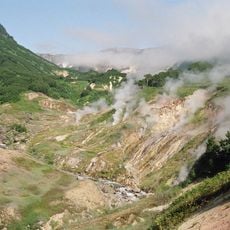
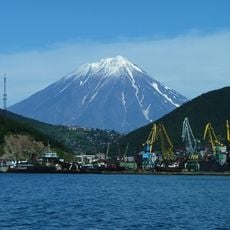
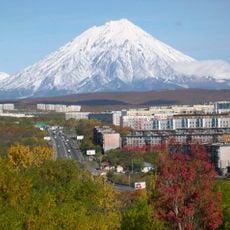
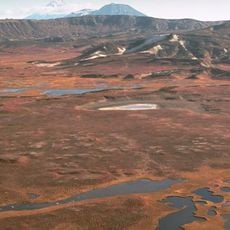
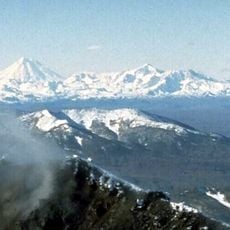
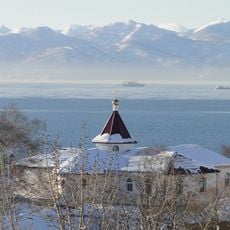
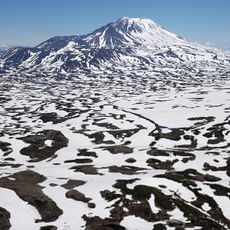
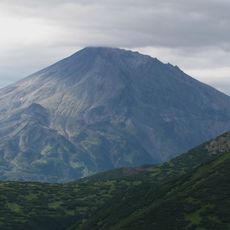
Zhupanovsky, Active stratovolcano in Kamchatka Peninsula, Russia
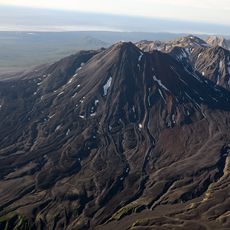
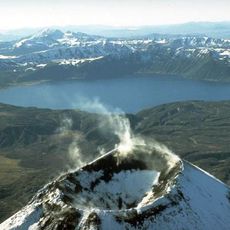
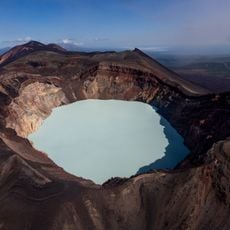
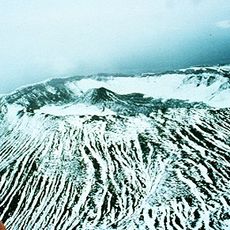
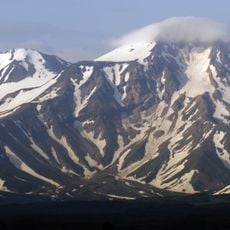
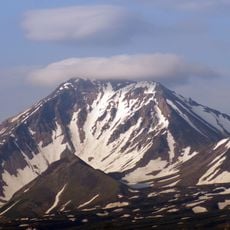
Zhupanovsky is an active stratovolcano in the Eastern Range of Kamchatka Peninsula, standing at 2,923 meters. The volcanic complex consists of four connected stratovolcanoes that together form a single massive structure.
Zhupanovsky began forming about 50,000 years ago: three of its four overlapping stratovolcanoes date from the Pleistocene, while the fourth, Holocene cone is the source of all recorded eruptions. Its last major eruption occurred around 800–900 AD. Seven eruptions have been documented since the late 18th century, the most recent in 2013 and 2014, after 54 years of inactivity.
The name Zhupanovsky comes from the Zhupanova River, which drains the massif's slopes. The volcano's activity is recorded in Russian scientific literature from the late 18th century, when seven eruptions were documented, and it appears in the Brockhaus and Efron Encyclopedic Dictionary of 1890–1907 as Zhupanovskaya Sopka.
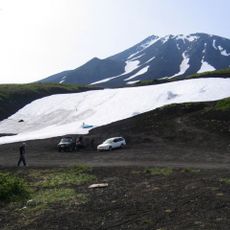
The location is extremely remote in the Kamchatka region and is typically accessed by researchers through specialized expeditions. Visitors should prepare for harsh weather conditions and difficult terrain, which require strong physical fitness and proper equipment.
Zhupanovsky is a massif of four overlapping stratovolcanoes; three formed in the Pleistocene and the fourth in the Holocene, and that youngest cone is the source of all its recorded eruptions. Its last major eruption occurred around 800–900 AD, and seven eruptions have been documented since the late 18th century.
The community of curious travelers
AroundUs brings together thousands of curated places, local tips, and hidden gems, enriched daily by 93,146 contributors worldwide.