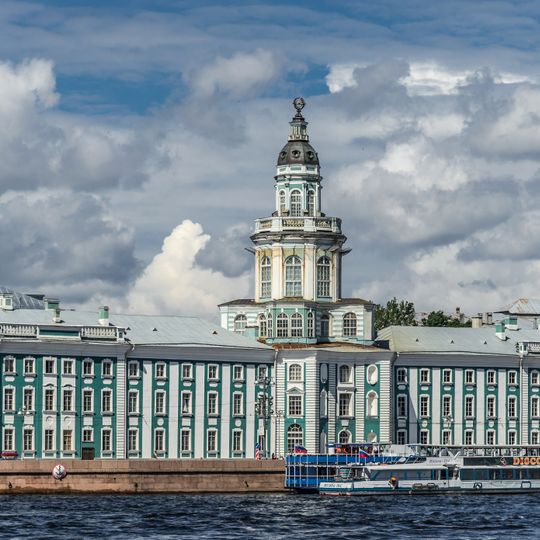
Kunstkamera, Anthropology and ethnography museum on Universitetskaya Embankment, Vasilyevsky Island, Saint Petersburg, Russia
The Kunstkamera is an anthropology and ethnography museum in Saint Petersburg, housed in a baroque building with a blue and white facade and a central tower topped by a dome. The structure stands directly on the Neva River embankment and spans several floors with exhibition rooms organized by geographic regions.
Peter the Great founded the institution in 1714 as Russia's first scientific museum and commissioned a dedicated building, which was constructed between 1718 and 1734. The institution aimed to bring Western science and Enlightenment ideas to Russia and systematically collected ethnographic objects from all known continents.
The Russian name translates directly to art chamber and reflects the European tradition of cabinets of curiosity, where rulers collected rare objects from around the world. Visitors today see exhibits from Siberia, Asia and the Americas, showing how people live and work in different climates and regions.
The museum occupies a building on the Universitetskaya Embankment, facing the Winter Palace across the Neva. The tower is not open for climbing; the Armillary Sphere that crowns the spire is seen from outside. Collections are spread over several floors, and the building is a federal cultural heritage site.
The tower's Armillary Sphere crowns the spire, and the Gottorf Globe was kept there from 1754 after a fire on 5 December 1747 destroyed the original globe, the tower and about 230 books, including old Russian manuscripts.
The community of curious travelers
AroundUs brings together thousands of curated places, local tips, and hidden gems, enriched daily by 93,676 contributors worldwide.