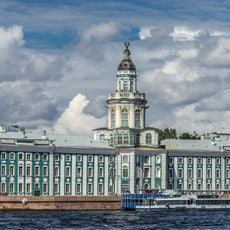
Asiatic Museum, Eastern studies museum on Vasilievsky Island, Saint Petersburg, Russia
The Asiatic Museum was a Saint Petersburg collection of oriental manuscripts and books, founded in 1818 within the Russian Academy of Sciences and housed in the Kunstkammer building until 1861. From 1849 to 1894 it published the journal Mélanges asiatiques. In 1930 it was merged into the Institute of Oriental Studies, and its manuscripts now form the core of the Institute of Oriental Manuscripts at Palace Embankment 18.
The Russian Academy of Sciences founded the museum in 1818 with Arabic manuscripts from French consul Jean-Baptiste Rousseau's collection. In 1930, it merged with the Institute of Oriental Manuscripts and has remained part of the Academy ever since.
The museum's name comes from its founding purpose: storing and studying manuscripts and books written in Arabic script and other Asian writing systems. From 1849 to 1894 it published the journal Mélanges asiatiques. Its collections include Sogdian manuscripts brought from Toyuk-Mazar by the expeditions of P. K. Kozlov and V. I. Roborovsky, and a copy of the Quran known as Katta Langar.
The institute occupies the building at Palace Embankment 18, a site assigned to it in 1949. It stands on the Neva side of Vasilievsky Island, a short walk from the Kunstkammer, where the manuscript collection was first kept from 1818 until 1861. Access is for researchers consulting the manuscripts and library rather than for general museum visits.
The museum's founding collection came from Jean-Baptiste Rousseau, French consul in Aleppo and Tripoli, who sold his Arabic-script manuscripts to the Academy; purchases were made in two tranches, in 1819 and 1825. Until 1861 the museum occupied rooms in the Kunstkammer building.
The community of curious travelers
AroundUs brings together thousands of curated places, local tips, and hidden gems, enriched daily by 94,257 contributors worldwide.