Magnitnaya, iron ore mountain in Magnitogorsk, Chelyabinsk Oblast, Russia
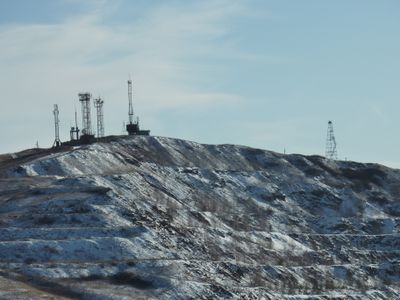
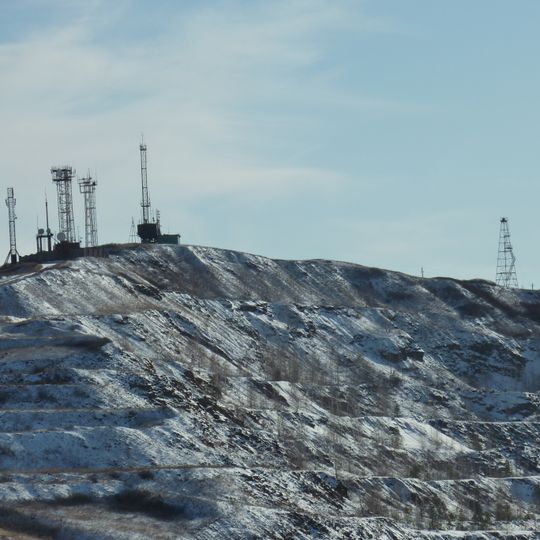
Magnitnaya is a group of hills on the left, Asian bank of the Ural River within Magnitogorsk, comprising the peaks Atach, Dalnyaya, Uzyanka (also called Magnitnaya), Yezhovka and Beryozovaya, covering about 25 km². The hills consist of Lower Carboniferous limestone and sandstone intruded by granite and diabase, with a large magnetite deposit at the contact. Much of the mountain has been quarried away; the height is given as 616 m.
The iron ore deposits here were discovered in 1740 by a local foreman, which later led to the development of one of Russia's major industrial cities. This discovery fundamentally transformed the entire region into a center for mining and steel production.
The name Magnitnaya comes from the Russian word for "magnetic", after the iron ore that made the mountain known. The Bashkirs called it Atach (Әтәс) and mined iron and steel from it until mining was banned in 1735. The nearby Cossack stanitsa of Magnitnaya, founded in 1743 as a fortress, later grew into the city of Magnitogorsk.
The mountain is visible from the city and accessible to visitors interested in exploring its geological features and industrial heritage. The best time to visit is during warmer months when roads and walking paths are in better condition.
The mountain is not a single peak but a group of hills: Atach, Dalnyaya, Uzyanka (also called Magnitnaya), Yezhovka and Beryozovaya, covering about 25 km². The ore body formed where sedimentary limestone and sandstone meet intruded granite and diabase. Most of the hill has now been quarried away.
The community of curious travelers
AroundUs brings together thousands of curated places, local tips, and hidden gems, enriched daily by 93,218 contributors worldwide.