Victory Bridge, Cultural heritage bridge in Voykovsky District, Moscow, Russia
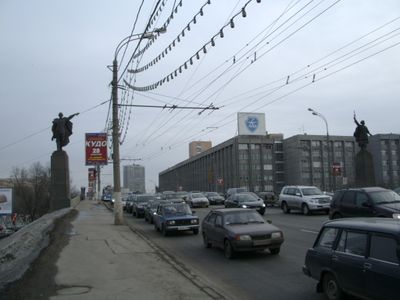
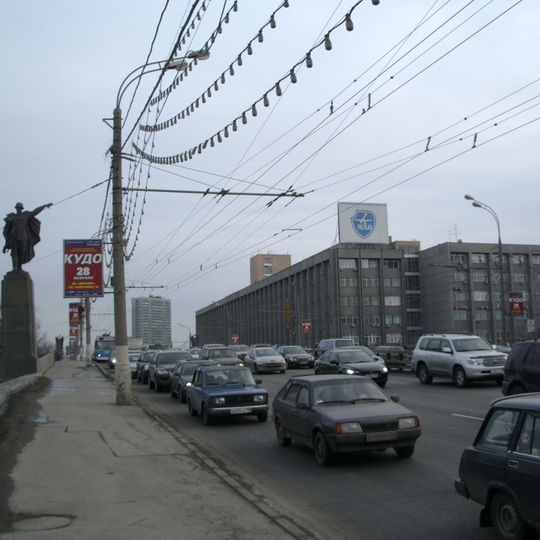
Victory Bridge is a reinforced-concrete beam overpass of four spans carrying the Leningrad Highway over the Riga railway line between the Sokol and Voykovsky districts. It is 132 metres long and 35 metres wide, with four lanes in each direction. At its northern end stand statues of a male and a female soldier on tall pedestals; at the southern end are two sculptural groups titled "Glory to Russian Arms".
The bridge was built starting in 1943 during World War II and was one of Moscow's first Victory monuments. Engineer Ermolin and architect Chechulin shaped its design as a landmark of the era.
The bridge displays sculptures of male and female soldiers on tall pedestals at its northern section. These figures commemorate the defense of Moscow and shape how the place looks to anyone passing through.
The bridge carries the Leningradskoye Highway over the Riga railway line, linking the Sokol and Voykovsky districts. Its roadway has four lanes in each direction, so cross on the walkways beside the parapet rather than the carriageway. The northern statues stand on tall pedestals at the bridge ends, and the southern compositions face the other way.
Sculptor Nikolai Tomsky designed the soldier silhouettes to convey the tension and fear people felt during Moscow's defense in 1941. This artistic choice makes the sculptures emotionally compelling and sets them apart from other war memorials.
The community of curious travelers
AroundUs brings together thousands of curated places, local tips, and hidden gems, enriched daily by 94,090 contributors worldwide.