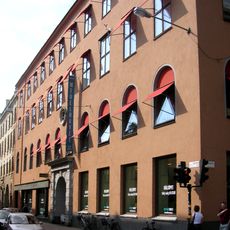
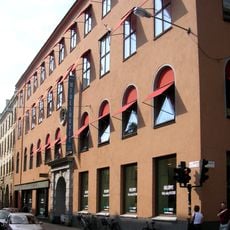
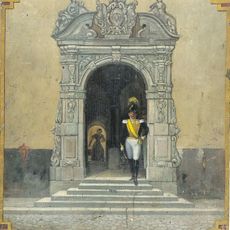
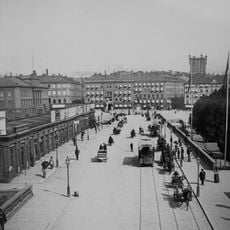
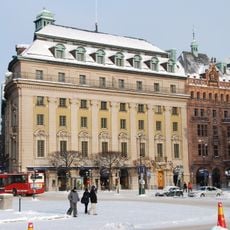
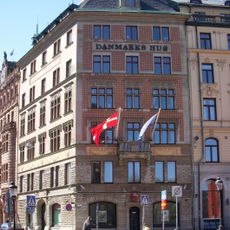
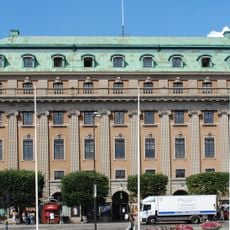
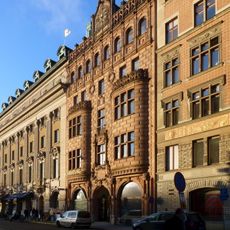
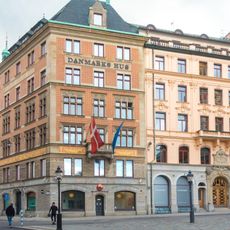
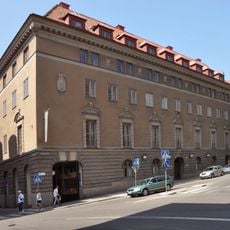
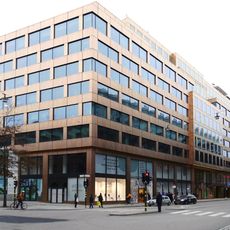
Gustav Adolfs torg, Pedestrian zone in Norrmalm, Sweden.
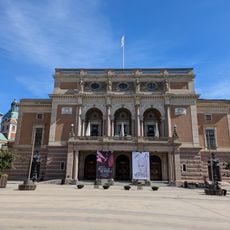
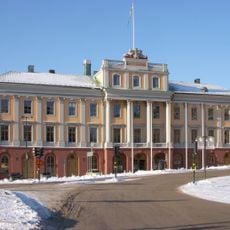
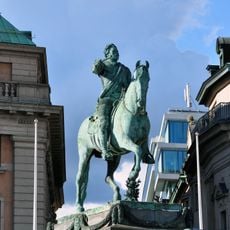
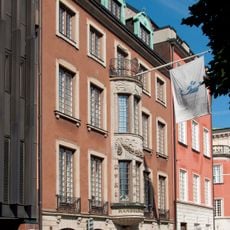
Gustav-Adolf-Platz is a pedestrian zone in central Stockholm positioned at the intersection of four major streets and dominated by an equestrian statue of King Gustav II Adolf. The space is surrounded by historic buildings, including the Royal Opera House and the Arvfursten Palace.
The site was a sand pit and medieval crossing called Sandbro before becoming a market square; it was named Malmtorget in the late 16th century and took its present name by royal letter on 12 March 1805. Pierre Hubert L'Archevêque's equestrian statue of Gustav II Adolf was cast in 1778, placed on the square in 1791 and unveiled in 1796. In 1743 the square was the scene of the Stora Daldansen, when troops fired on Dalecarlian rebels, killing about 150.
The Royal Opera House sits directly beside the square, where visitors and locals gather today. The place serves as a meeting point in the city's heart and connects different neighborhoods together.
The square is easy to reach and serves as a central reference point for measuring distances across Stockholm. Numerous walking paths and good transportation connections make it simple to explore the area and reach surrounding neighborhoods.
The two bronze lions stand at the northern end of Norrbro, not by the equestrian statue. They were placed there in 1926 and are copies of a group sculpted in the 4th century BC for the Egyptian pharaoh Nektanebo II; the originals are in the Vatican Museums.
The community of curious travelers
AroundUs brings together thousands of curated places, local tips, and hidden gems, enriched daily by 93,270 contributors worldwide.