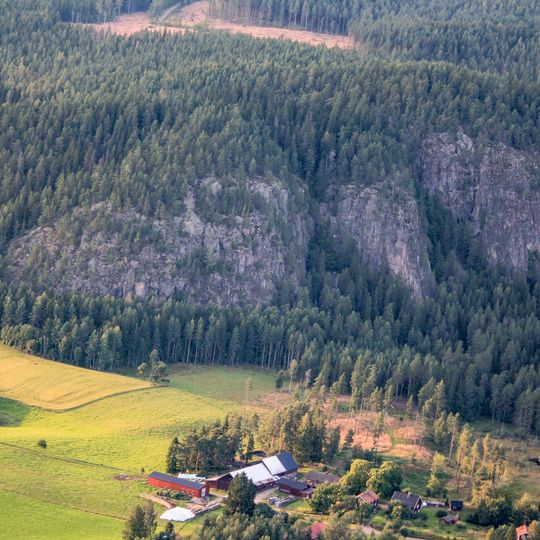
Bispbergs klack, Nature reserve and mountain in Säter Municipality, Sweden.
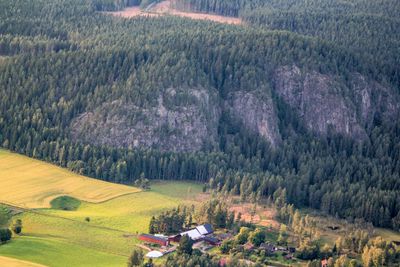
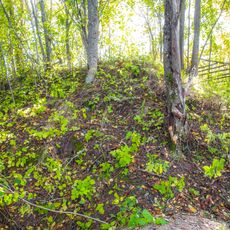
Bispbergs klack is a mountain by Bispberg in Säter Municipality, Dalarna County. Its steep southern face is up to 80 metres high, and the red granite walls together are nearly 400 metres wide. Below the cliff grow hazel, buckthorn and field forget-me-not, plants uncommon at this latitude.
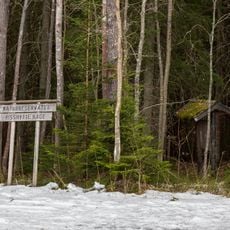
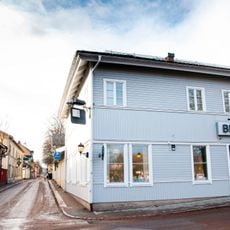
Climbing began on the mountain in 1967, and it became one of Sweden's most important crags, with about 160 routes of mainly easy to medium difficulty. Since 1996 the surrounding area has been a nature reserve, where climbing is forbidden. At the foot of the mountain lies the old mining village of Bispberg, where scheelite was first identified in mineral samples in 1751.
Below the cliff grows hazel, buckthorn and the forget-me-not Myosotis ramosissima, plants uncommon at this latitude; the mountain is a so-called south-facing cliff site. The Eurasian eagle-owl and the peregrine falcon sometimes nest on the rock. The old mining village of Bispberg lies at the foot of the mountain.
The cliff area lies within a nature reserve established in 1996, where climbing has been banned since the ban came into force; the roughly 160 routes from 1967 are closed. The rock face is on the steep south side, up to 80 m high and nearly 400 m wide. Approach from the Bispberg mining village at the foot of the mountain.
The south face is a red granite wall up to 80 metres high and nearly 400 metres wide. Below the cliff grow hazel, buckthorn and field forget-me-not, species unusual at this latitude, and eagle-owls and peregrine falcons sometimes nest on the rock.
The community of curious travelers
AroundUs brings together thousands of curated places, local tips, and hidden gems, enriched daily by 94,899 contributors worldwide.