Rogatec Open-Air Museum, Open-air museum in Slovenia
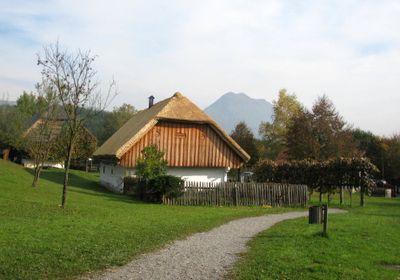
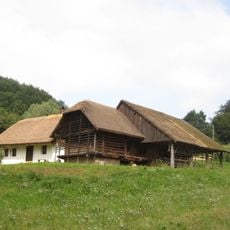
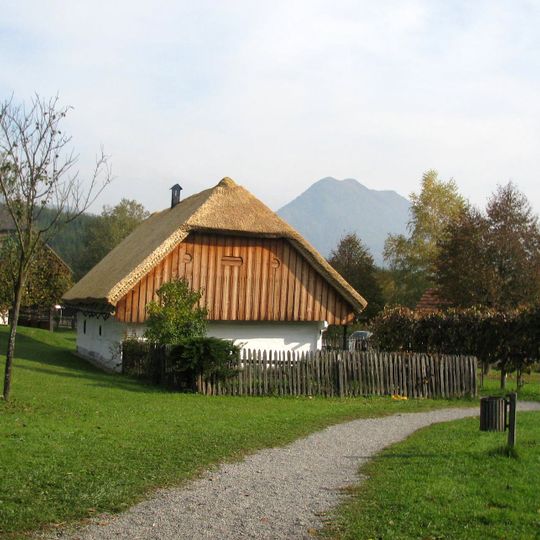
Rogatec Open-Air Museum is Slovenia's largest open-air museum, with buildings moved here from the slopes of Boč, Donačka Gora and Macelj. Its core is a wooden farmhouse from Tlake with a thatched roof, clay-plastered walls and an earthen floor, transferred in 1981. Around it stand a stone-and-wood barn, a double hayrack (toplar) dated 1892, a pigsty, a beehive shelter, a well and a reconstructed forge.
The museum opened in 1981 with the transfer of the Šmit family house from Tlak, the first building on the site. In 1999 it was declared a cultural monument of national importance. Its exhibits show peasant and craft life in the 19th and early 20th centuries, mainly from the slopes of Boč, Donačka Gora and Macelj.
The museum stages workshops where young visitors try the work, life and customs of the region's ancestors. Beekeeping shaped farm life here: honey served as sweetener, medicine and sedative, and wax became candles. Local hives were straw baskets called korbiči, not the painted kranjči panels common elsewhere in Slovenia.
The buildings stand on level ground around the Šmit farmhouse, the first structure moved here in 1981. The double hayrack (toplar) was brought from the Croatian village of Prišlin in 1892, as the carved year on its beam shows. Look for the S-shaped supports with hexagonal rosettes.
The central wooden house, transferred here in 1981, belonged to the Šmit family from Tlake and is the birthplace of the poet and translator Jože Šmit. Its walls are clay plastered and lime-washed, with a clay floor under a thatched roof.
The community of curious travelers
AroundUs brings together thousands of curated places, local tips, and hidden gems, enriched daily by 94,045 contributors worldwide.