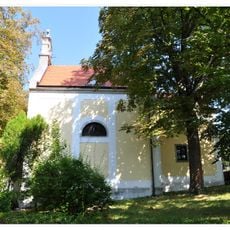
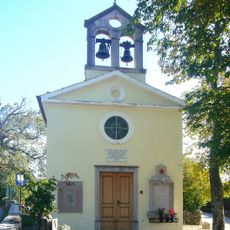
Sežana botanical park, 19th century botanical garden in Sežana, Slovenia
Sežana botanical park occupies a triangular site between Partizanska cesta and the Jesenice–Sežana railway line, covering two hectares. From the villa forecourt a geometric garden with box parterres, paths, a pond and pergolas leads to the 1890 palm house, a reduced copy of the Schönbrunn greenhouse. The lower part has looser groups of exotic trees, a maple avenue and stands of cedars and cypresses.
A Greek merchant family called Scaramangà started the garden in the mid-1800s, bringing back plants collected during their journeys abroad. Toward the end of that century, they constructed a large greenhouse based on the design of a famous European garden.
The name Mirasasso, chosen in 1848, means "looking at the stones", a deliberate contrast to Miramare near Trieste, "looking at the sea". The garden is protected as a horticultural monument and belongs to the Slovenian network of botanical gardens and arboreta. In the exhibition pavilion a small natural history museum holds a geological collection, a collection of minerals from Slovenian karst caves, an archaeological collection and a collection on the dinosaurs of Kozina.
The garden is open daily from 8 a.m., with closing times that vary by season; it is closed all day on 1 November, 25 December and 1 January. The entrance is on Repentaborska cesta, where a car park is shared with visitors to the nearby cemetery. The site lies between Partizanska cesta and the Jesenice–Sežana railway line.
The boxwood rondos in front of the greenhouse follow an Austrian model; the Balearic boxwood growing there comes from southern Spain and the Balearic Islands and is a rarity in this part of Europe. The garden also holds a small natural history museum with geological, mineral and archaeological collections and a display on dinosaurs from Kozina.
The community of curious travelers
AroundUs brings together thousands of curated places, local tips, and hidden gems, enriched daily by 94,458 contributors worldwide.