National Portrait Gallery, National art museum in Westminster, United Kingdom
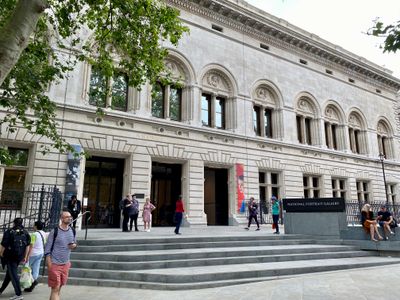
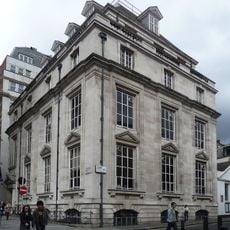
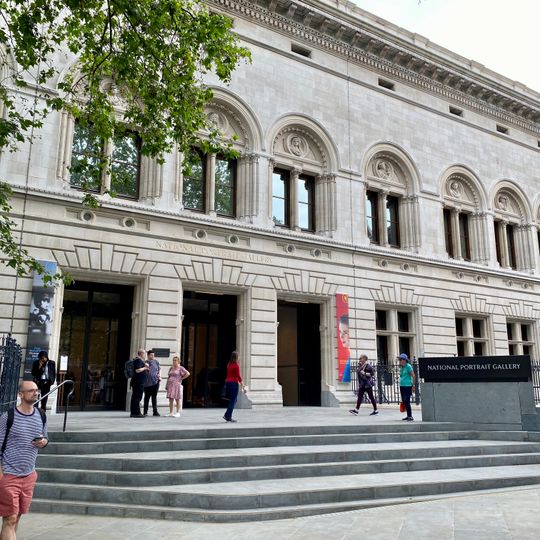
The National Portrait Gallery occupies a Renaissance Revival building of light grey and beige Portland stone at St Martin's Place, next to the National Gallery. Its facade has a wide flight of shallow steps, tall ground-floor openings, a row of arched windows with carved ornament, and a central round-headed entrance framed by rusticated stone beneath a sculpted coat of arms and a triangular pediment. Inside, galleries are arranged over several floors, and the Ondaatje Wing has a two-storey escalator leading to the Tudor portraits.
Parliament approved the founding in 1856, making it the first national public gallery devoted to portraits anywhere in the world. The building at St Martin's Place opened in 1896, designed by architect Ewan Christian in the Italian Renaissance manner.
The gallery selects sitters for their historical weight rather than the artist's fame, so a group portrait of the 1604 Somerset House Conference hangs as a historical document. The Chandos portrait, the best-known image of Shakespeare, was the collection's first gift, donated by Lord Ellesmere. Portraits of living people were only admitted from 1969.
Opening hours run from 10:30 to 18:00 Sunday through Thursday, with late hours until 21:00 on Friday and Saturday. Admission is free, though visitors may want to book online ahead to avoid any wait at the entrance.
During World War II, staff evacuated the entire collection to Mentmore Towers in Buckinghamshire alongside treasures from the Royal Collection. Today, some rooms use natural daylight from above, which changes how visitors see the colours and brushwork hour by hour.
The community of curious travelers
AroundUs brings together thousands of curated places, local tips, and hidden gems, enriched daily by 93,355 contributors worldwide.