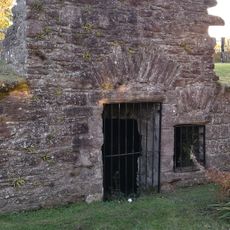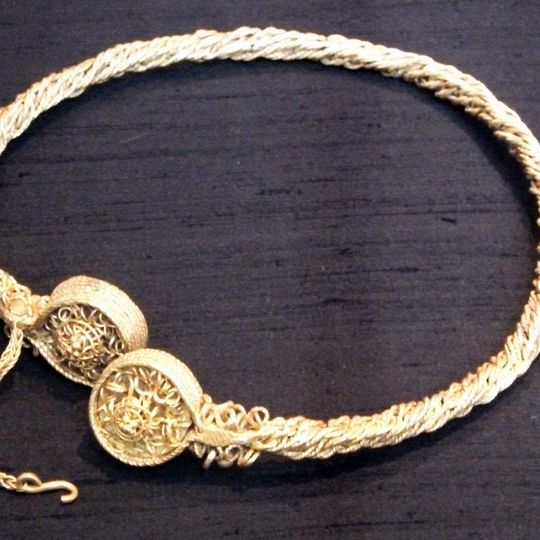
Stirling torcs, Archaeological find in Blair Drummond, Stirling, Scotland.
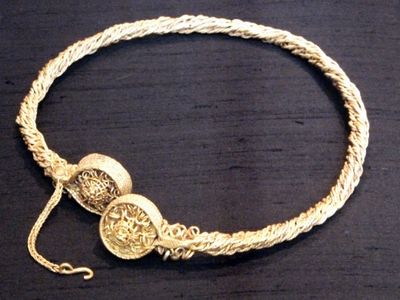
The Stirling torcs are four gold neck rings from the Iron Age, found near Stirling in Scotland, and now part of the collection at the National Museum of Scotland. The four pieces differ considerably from one another: one is made of twisted ribbons of gold, another is tubular, and two are formed from braided wires ending in decorated terminals.
The rings were made between 300 and 100 BC, during the British Iron Age. They came to light in 2009 when a metal detector user found them buried beneath the remains of an ancient roundhouse, where they had been hidden for nearly 2,000 years.
The torcs show craftsmanship rooted in traditions from Ireland and France, which suggests the people who made or owned them had connections far beyond Scotland. Looking at the four pieces side by side, it becomes clear that each one was made using a different technique, pointing to a variety of sources of knowledge.
The torcs are on display at the National Museum of Scotland in Edinburgh, where they can be seen as part of the permanent collection. It is worth checking the museum's opening hours before visiting, as some objects may occasionally be moved for special exhibitions.
One of the four rings features an eight-wire gold braid fitted with a safety chain, a construction that is rare in Iron Age northern Europe. This detail points to a craftsperson who was familiar with techniques more commonly linked to the Mediterranean world.
The community of curious travelers
AroundUs brings together thousands of curated places, local tips, and hidden gems, enriched daily by 90,839 contributors worldwide.