Fuente Álamo, Argaric archaeological site in Cuevas del Almanzora, Almería, Spain
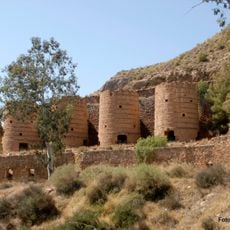
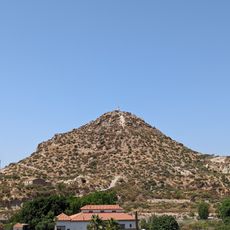
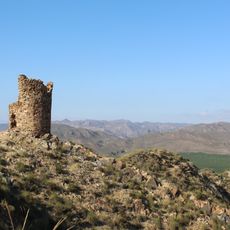
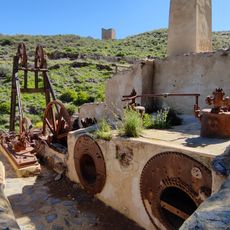
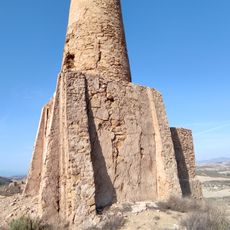
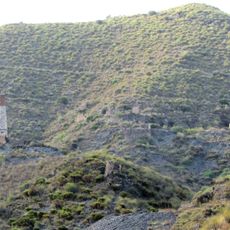
Fuente Álamo is an Argaric settlement on a hill in the Sierra de Almagro, near Cuevas del Almanzora. Its summit was fortified and held two rectangular towers and four round stone granaries; houses spread over terraces on the south slope. Excavations have uncovered a cistern and a metallurgist's grave.
The hill was first settled around 2200 BCE, and the site was occupied through the Argaric Bronze Age, with most material from El Argar phases III and IV (c. 1900–1550 BCE). Occupation continued into Iberian-Roman and medieval times. The Siret brothers surveyed the area around 1884 while prospecting for silver; excavations resumed in 1977 under Hermanfrid Schubart and Oswaldo Arteaga.
The site gave its name to the El Argar culture: the Siret brothers, Belgian mining engineers, named it after the nearby hill. Excavations uncovered a "metallurgist's grave" (grave 54), a man of 40 to 60 years buried with a staff dagger, a dagger and a grinding slab worn from use, fixed to his left upper arm.
The site lies on the slopes of a hill in the Sierra de Almagro, in the municipality of Cuevas del Almanzora, reached from the Almanzora valley. Excavations covered only about 8% of the roughly 2-hectare settlement, so most of the hilltop and its terraces remain unexcavated. Expect uneven ground on the slopes.
Grave 54 held a man of 40 to 60 years, buried with a staff dagger, a dagger and a medium-sized vessel; a grinding slab showing wear was fixed to the outside of his left upper arm. Archaeologists call it the metalworker's grave, and about 75% of all metalworking tools found at Fuente Álamo come from the hilltop and east slope where he lay.
The community of curious travelers
AroundUs brings together thousands of curated places, local tips, and hidden gems, enriched daily by 94,542 contributors worldwide.