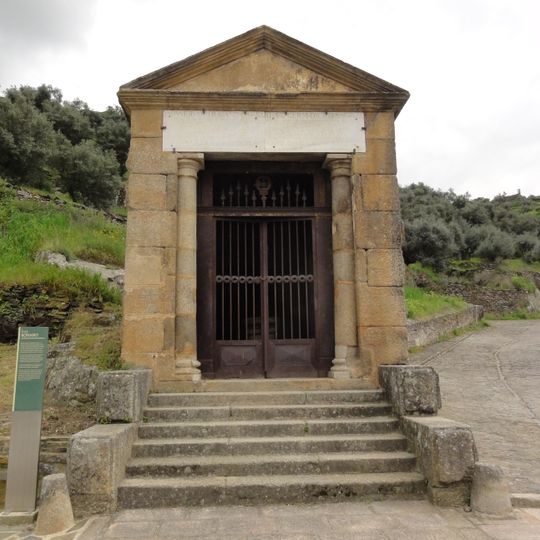
Roman temple of Alcántara, Roman temple in Alcántara, Spain.
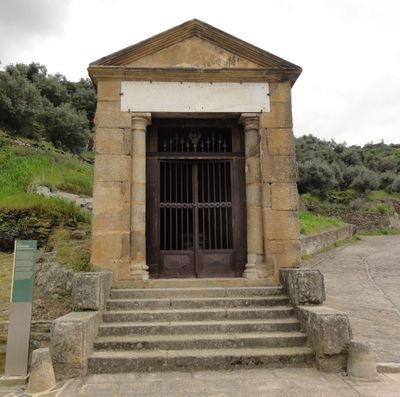
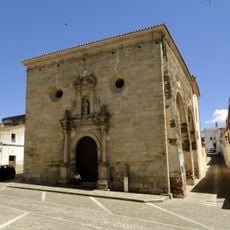
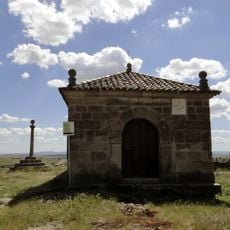
The Roman temple of Alcántara stands beside the southern entrance of the Alcántara Bridge in Cáceres, Extremadura. It is a small rectangular votive temple in antis, built of granite blocks cut to the same size as those of the bridge. Two Tuscan columns frame the entrance, reached by an outside staircase, and a gabled stone-slab roof ends in a pediment with a plain tympanum. Inside, the single cella was divided into naos and pronaos.
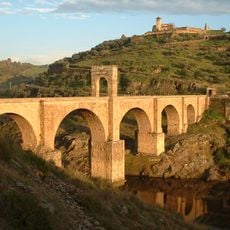
Gaius Julius Lacer designed the bridge, triumphal arch and temple as one project, finishing in 103 AD; the temple was an offering to Trajan and the gods of Rome. After Ferdinand II of León took Cáceres in 1169, it became the chapel of St. Julian, which helped it survive. A belfry and a skull with tibias were added; the belfry is gone and the skull now sits at the rear.
The structure was repurposed as a chapel dedicated to Saint Julian following medieval conquest, transforming it into a place of Christian worship. This conversion shows how Roman buildings were adapted to fit new religious needs across centuries.
The temple sits directly beside Alcántara Bridge and is easy to locate near this well-known landmark. Access is gained via the external staircase, and visitors benefit from exploring the area on foot to appreciate both the temple and bridge within their surrounding landscape.
The architect who designed and built this structure was laid to rest within the temple itself, a burial practice that honored his role in its creation. This unusual choice reflects the importance placed on both the building and its creator in Roman times.
The community of curious travelers
AroundUs brings together thousands of curated places, local tips, and hidden gems, enriched daily by 95,680 contributors worldwide.