Mare de Déu del Coll, Romanesque church in Gràcia district, Barcelona, Spain.
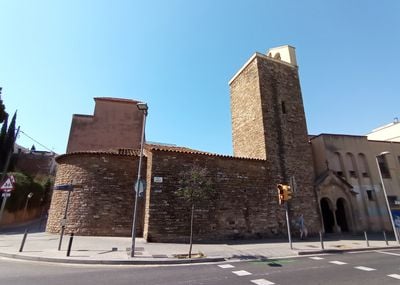
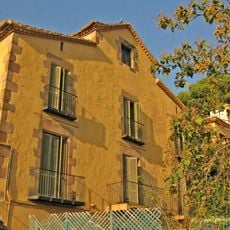
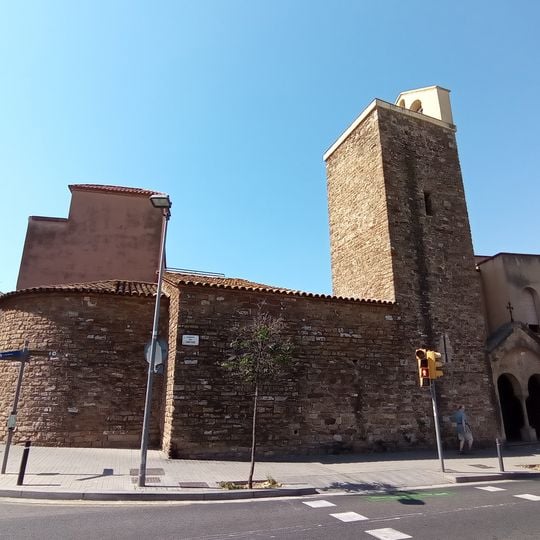
Mare de Déu del Coll is a church with Romanesque roots located in Barcelona's Gràcia district, situated where two streets intersect. The building displays a reinforced central section and a distinctive bell tower that defines its outer look.
Documented in the 11th century, when Grau Miró donated the sanctuary of Coll to the Monastery of Sant Cugat. The chapel, at a crossroads on the Vallcarca-to-Horta path, became a monastery dependent on Sant Cugat; military events, especially in 1714, damaged it. Closed for worship between 1835 and 1928 after the confiscation, it reopened in 1928. Around 1930 the transept, vault and apse were added in a Romanesque-matching style; the interior was burned during the Spanish Civil War and restored in 1948 by Josep Maria Ros i Vila.
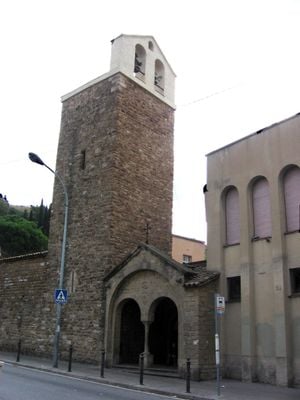
The church is also known as Mare de Déu de Font-rúbia, after the reddish spring that once stood here; the area was noted for the quantity and quality of its water. In the entrance porch, a 20th-century carving shows a hand giving the Christian blessing: three fingers extended for the Trinity, two folded for the two natures of Christ. The 13th-century Virgin image was restored in 1929.
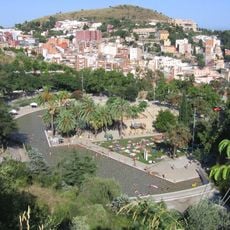
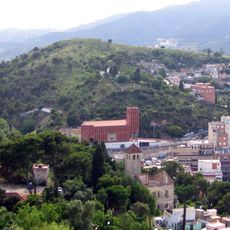
The church stands at the foot of the Carmel hill, where the old road from Vallcarca to Horta crossed, and the surrounding streets carry the name Coll. The building is in urban terrain today, so it is reached on foot from the Gràcia streets; the entrance porch with the blessing hand faces the street. Look for the small rectangular sign on the long wall.
The bell tower originally served as a defence tower, and its bell gable was added later. The entrance porch, built in the 20th century, carries a hand giving the Christian blessing: three fingers extended for the Trinity, two folded for the two natures of Christ.
The community of curious travelers
AroundUs brings together thousands of curated places, local tips, and hidden gems, enriched daily by 95,316 contributors worldwide.