Monument to the Spanish Constitution of 1978, Madrid, Constitutional monument in El Viso, Madrid, Spain
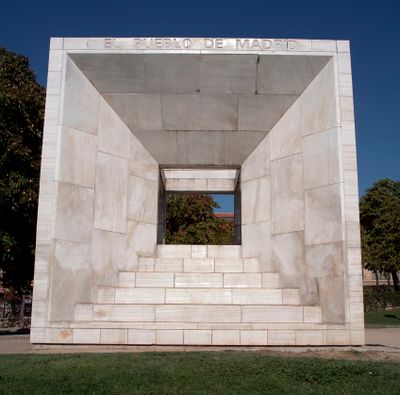
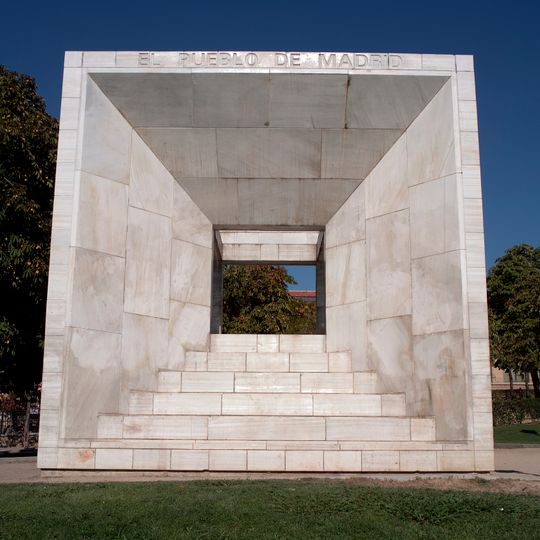
The Monument to the Spanish Constitution of 1978 stands in the Jardines del Bellas Artes, facing the Museo de Ciencias Naturales. It is a concrete cube 7.75 metres on each side, clad in 60 tonnes of white Macael marble donated by that Almería municipality. Inside, a second empty cube 1.83 metres wide, the height of a person, is linked to the outer shell by 45-degree slopes; the lower ones form six-step stairs that visitors can climb.
The monument was inaugurated in 1982 and marks Spain's transition from Franco's dictatorship to a democratic parliamentary system. The 1978 Constitution was the crucial document that enabled this shift in the country's direction.
The inner void measures 1.83 metres, the height of a person, and the architect intended citizens to climb the 45-degree ramps and six-step stairs to fill and activate the cube. The ascent, in his reading, stands for the drive toward democracy; the upper steps were later covered with marble slabs without consulting him.
The monument stands in the Jardines del Bellas Artes, facing the Museo Nacional de Ciencias Naturales, at the junction of Calle de Vitruvio and Paseo de la Castellana, near Plaza de San Juan de la Cruz. The base and upper slopes are built as stairways, so pedestrians can walk up and into the hollow interior cube. The upper steps were later covered with marble slabs without consulting the architect.
The monument is often read as a tesseract, the four-dimensional analogue of a cube, a term coined by Charles Howard Hinton in 1888 in A New Era of Thought. The architect stated it was not inspired by Hinton's book, nor by Max Bill's 1956 Monument to the Unknown Political Prisoner in London; the resemblance comes from the purity of the form.
The community of curious travelers
AroundUs brings together thousands of curated places, local tips, and hidden gems, enriched daily by 94,736 contributors worldwide.