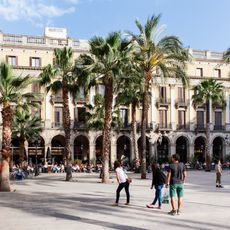
Lampadaire de la place Royale, Modernist streetlight in Gothic Quarter, Spain
The lampadaire de la place Royale is a six-armed streetlight made of cast and wrought iron in central Barcelona's old quarter. The light fixture features ornamental details along its central post, including intertwined snakes and symbolic elements inspired by classical mythology.
Gaudí received the commission on 15 March 1878, before his architect's diploma was issued on 15 May, after the death of the original choice, Jaume Serra i Gibert, and on the recommendation of Joan Martorell. The city approved the two-lamp option on 31 January 1879, and the lamps were inaugurated on 24 September 1879 during the Mercè festivities. A three-armed model was later placed at the Pla de Palau.
The two lamps flank the Fountain of the Three Graces, installed in 1876 after a plaster statue of Ferdinand the Catholic was stoned by locals. Gaudí's design includes the city's coat of arms and a winged helmet with two coiled snakes, the caduceus of Mercury, linking commerce to Barcelona.
The two lamps stand on the Plaça Reial, set on either side of the Fountain of the Three Graces, across the square's rectangle. They are reached on foot from the Rambla through the square's arcades. The originals burned gas; the glass lamps were later replaced by metal half-spheres.
The two lamps flank the Fountain of the Three Graces, copied from an 1866 Antoine Durenne model, and stand crosswise to the square's rectangle. Gaudí had proposed four lamps in a square around the fountain; the city approved only two on 31 January 1879, and they were lit on 24 September 1879 during the Mercè festivities.
The community of curious travelers
AroundUs brings together thousands of curated places, local tips, and hidden gems, enriched daily by 93,390 contributors worldwide.