Rosarito Reservoir, Reservoir in the provinces of Ávila and Toledo, Spain
Rosarito Reservoir is a body of water on the border between the provinces of Ávila and Toledo, formed by a dam built across the river Tietar. The shoreline is lined with trees and low shrubs, and the water surface opens broadly across a shallow valley.
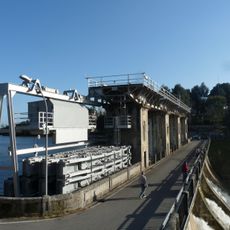
The Rosarito dam is a gravity dam with gate-controlled regulation that holds back the Tiétar in the Tagus basin, creating a reservoir of 82 hm³ fed by a catchment of 1754 km². Its shores lie in Candeleda (Ávila) and in Oropesa, Lagartera and La Calzada de Oropesa (Toledo).
The reservoir's shores lie in the municipalities of Candeleda (Ávila) and Oropesa, Lagartera and La Calzada de Oropesa (Toledo), so the water is shared by two provinces. Its main draw is the wintering common crane: in 2007, 6,912 cranes were counted here, the largest wintering site in Castilla-La Mancha and the third largest in Spain.
The reservoir lies between the provinces of Ávila and Toledo, with shores in Candeleda, Oropesa, Lagartera and La Calzada de Oropesa. The dam is a gravity structure with gate regulation, and the catchment covers 1754 km². Approach by road from these municipalities; the source gives no public transport, campsite or dock details.
Every winter, large groups of gray cranes stop at this reservoir during their migration between Europe and Africa. At peak times, observers have counted up to 7,000 birds resting here at once, making it one of the notable crane stops in central Spain.
The community of curious travelers
AroundUs brings together thousands of curated places, local tips, and hidden gems, enriched daily by 94,583 contributors worldwide.