Palacio de Abrantes, 16th century palace in Granada, Spain
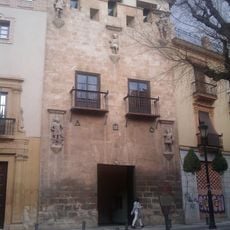
The Palacio de Abrantes is a 16th century palace in Granada with a Gothic facade decorated with heraldic symbols and iron-studded wooden doors. The structure contains two floors and a tower, with ground-level windows protected by iron bars.
The palace dates from the early 16th century; its Gothic stone portal and the coffered ceilings of the staircase and main hall survive from that phase. Its promoter was Antonio de Bobadilla y Peñalosa, son of Francisco Peñalosa, one of the conquerors of Granada. A 19th-century renovation erased most of the original layout, leaving an historicist building mixing neo-Arab and neo-Renaissance decoration.
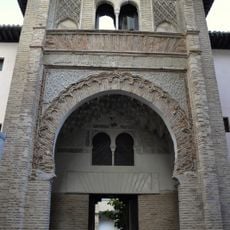
The palace's name comes from the ducal title of Abrantes, inherited by Antonio de Bobadilla y Peñalosa, son of Francisco Peñalosa, one of the conquerors of Granada. Inside, the vestibule arch reproduces a Nasrid design on paired white marble columns reused from earlier Nasrid buildings, while the upper salons show Neo-Renaissance plasterwork from the 19th-century renovation.
The palace has a single main facade facing the Placeta de Tovar, in the centre of Granada; the other sides are party walls shared with neighbouring buildings. Entry is through a vestibule with two side rooms, then steps up to a plasterwork arch on paired white marble columns. A three-flight staircase leads to the upper floor.
Four Nasrid marble columns reused in the entrance hall are all that remain of the Arab columns once lining the original galleries. The staircase ceiling, an octagonal wooden framework with flat pendentives and interlaced strapwork, survives from the early 16th-century building.
The community of curious travelers
AroundUs brings together thousands of curated places, local tips, and hidden gems, enriched daily by 94,078 contributors worldwide.