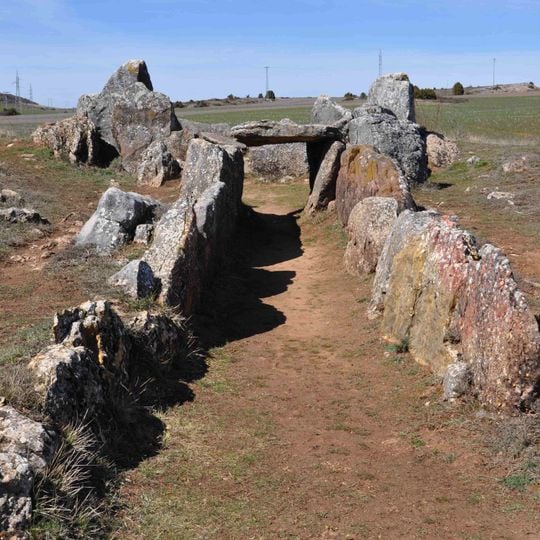
Dolmen de Cubillejo de Lara, Neolithic dolmen in Mambrillas de Lara, Spain.
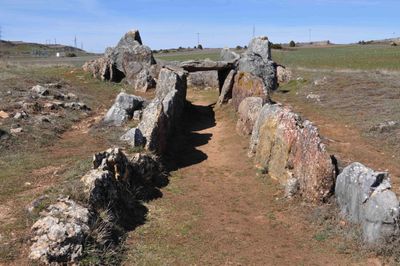
The Dolmen of Cubillejo de Lara is a gallery grave with its entrance facing east, built of limestone and conglomerate blocks. Its chamber is about 6.0 m across and made of 10 megaliths; a passage roughly 10.5 m long is formed by two rows of six uprights each, narrowing from 1.5 m to 0.75 m at the chamber door. The capstones are lost, and one passage orthostat bears eroded carvings of animals and adorants.
The burial site was built around 3000 BCE when early farming communities settled in this region. It served as a shared burial ground for these groups over an extended period.
The finds from the 1970s excavation include a bracelet of Mediterranean origin, two greenish beads of callaïs, flint flakes and two pottery fragments, one belonging to the Bell Beaker horizon. The bracelet lay beside fragmented human bones. The grave goods show links with distant regions.
The dolmen sits where two streams meet and is easily reached by foot. Visitors can walk to the site from the nearby villages of Cubillejo de Lara or Mazariegos.
The passage opens to the east, and the chamber measures about 6.0 m across, built from ten limestone and conglomerate megaliths. Inside, one corridor orthostat carries a panel of heavily eroded petroglyphs showing animals and adorants, cut with stab marks rather than the usual circles and spirals.
The community of curious travelers
AroundUs brings together thousands of curated places, local tips, and hidden gems, enriched daily by 95,297 contributors worldwide.